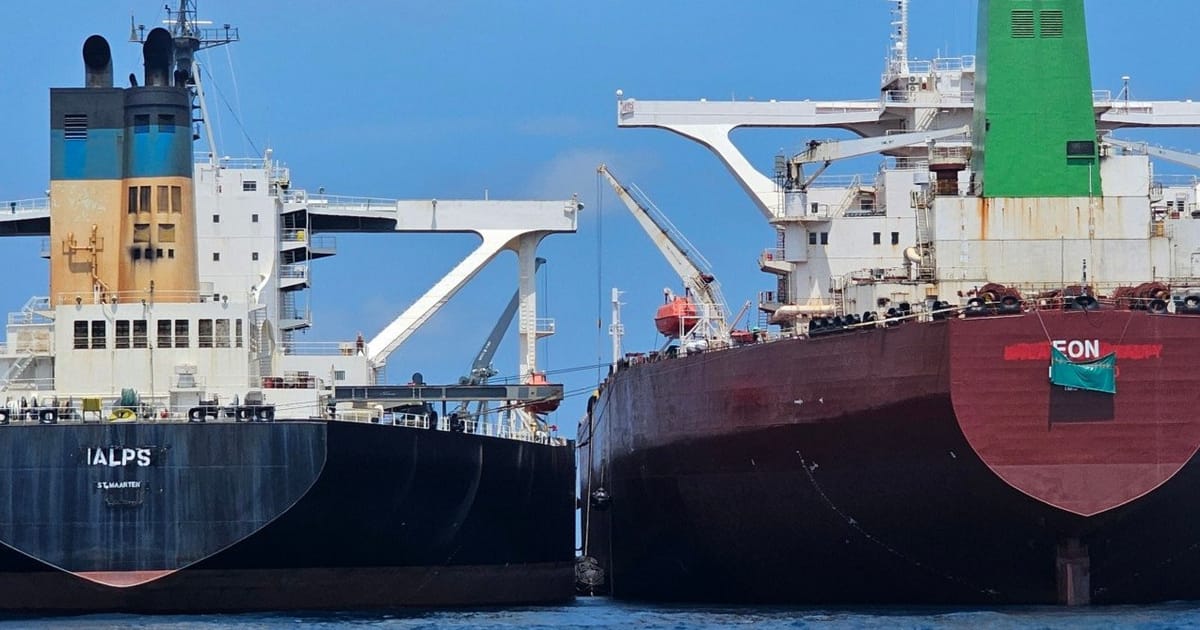
Satellite imagery tracked at least 42 ship-to-ship transfers of Iranian oil near Malaysia's Johor state, underscoring Tehran's ongoing sanctions-evasion network despite US pressure and a naval blockade. The activity points to continued crude flows to China, which buys roughly 90% of Iranian exports, while raising legal, safety and enforcement risks in a major shipping corridor. The article is primarily geopolitical and sanctions-related, with limited direct near-term market impact beyond the energy and tanker shipping sectors.
The market implication is not “more Iranian barrels” so much as a redistribution of sanctioning power: enforcement is being pushed from origin controls to maritime surveillance, where the weakest link is jurisdictional fragmentation. That usually benefits the lowest-friction buyers and intermediaries first — Chinese independent refiners, dark-fleet operators, and any logistics/insurance ecosystem willing to price in opacity — while penalizing compliant regional shipping and port service providers through higher screening costs and slower turnaround.
Second-order effect: if these transfers continue at scale, the true risk premium migrates from headline crude benchmarks into freight, marine insurance, and vessel residual values. Aging tankers used in shadow networks should see elevated utilization and cash generation until a policy shock hits, but their financing curves get more fragile: one detainment or insurance withdrawal can strand multiple voyages and create abrupt tonnage scarcity. That makes the trade asymmetric because the visible barrel flow can persist even as the tradable fleet quality deteriorates.
The key catalyst is not U.S. rhetoric but whether Malaysia/Indonesia begin systematic AIS, port-state, or coast-guard enforcement in the next 1-3 months. If they do, the network doesn’t disappear — it reroutes, likely increasing voyage length and freight costs, which squeezes netbacks and reduces Iran’s effective realized price. Conversely, a weak response keeps the model intact and signals sanctions leakage is structurally underpriced.
Contrarian view: the market may be overfocused on the headline supply loss and underestimating how resilient the shadow system is, but it may also be underpricing a future jump in enforcement efficiency if any one chokepoint chooses to cooperate. The highest-conviction read is that Iranian exports remain intact near term, but the risk-reward has shifted toward a tail event where one or two regulatory actions abruptly tighten the logistics chain rather than the oil market itself.
AI-powered research, real-time alerts, and portfolio analytics for institutional investors.
Request DemoOverall Sentiment
mildly negative
Sentiment Score
-0.20
