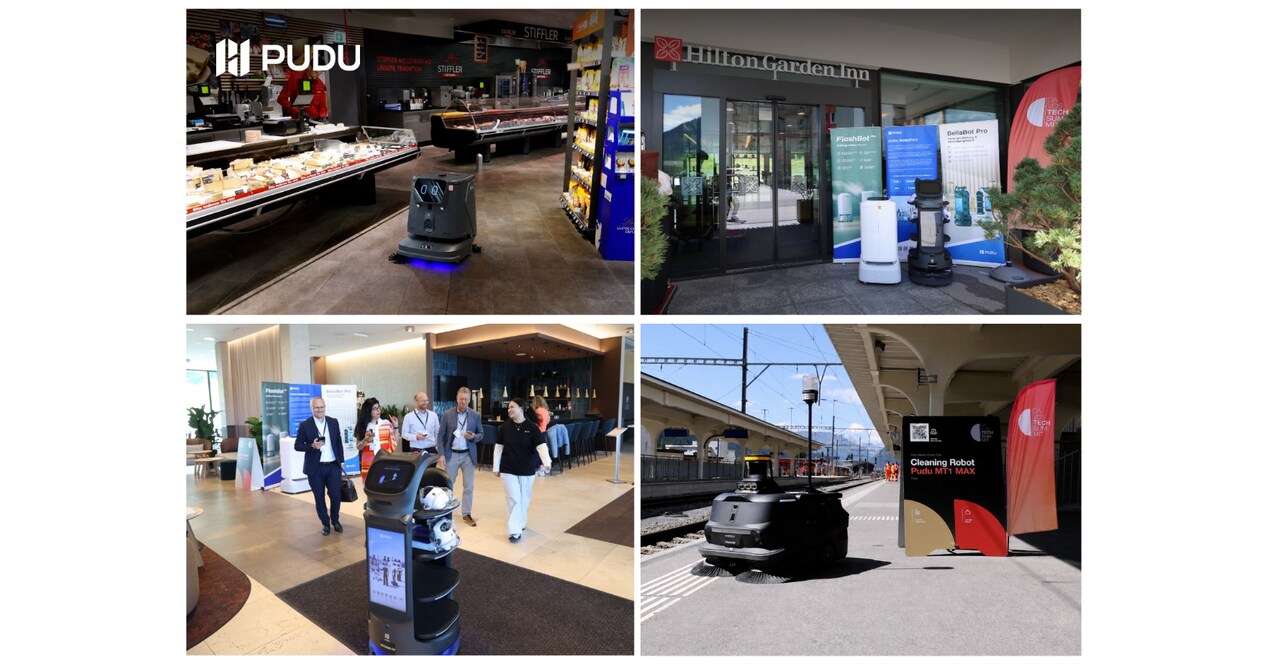
Pudu Robotics showcased “Physical AI” deployments at Davos Tech Summit’s Robot City, deploying four robots across retail (SPAR floor cleaning), hotel services (Hilton), and a train-station plaza (Davos outdoor cleaning). The company highlights its unified “One Brain, Multiple Embodiments” embodied AI architecture (PuduFM + PuduAgent) aimed at reducing deployment complexity and improving fleet coordination across international markets. Pudu said it has delivered 130,000+ robots across 85 countries and noted a June 2026 deal to deploy 200 CC1 cleaning robots with Swiss retailer Denner, supporting continued commercial rollout beyond demonstrations.
This reads less like a product launch and more like a proof-of-deployment pitch: the investable variable is not robot capability, but whether the software stack turns into repeatable fleet economics. If that works, the biggest beneficiaries are the “arms dealers” of automation — industrial platforms, sensors, building-integration vendors, and maintenance/service providers — not the robot OEM alone. The real moat becomes install base plus orchestration, which tends to favor incumbents with distribution and after-sales infrastructure over pure hardware names.
The clearest loser set is labor-arbitrage businesses where repetitive cleaning, delivery, and front-desk tasks are a core input. Public comps most exposed are outsourced facility-services names like ABM, where even modest robot penetration can cap wage pass-through and pressure renewal pricing, but the effect is likely months to years rather than quarters. Near term, this is mostly a sentiment tailwind for the robotics basket; the actual P&L impact depends on utilization rates, service uptime, and whether deployment costs fall fast enough to clear payback hurdles.
Contrarian view: the market may be underpricing the network effects from data collection and integration, but overpricing how quickly those effects translate into earnings. These deployments still need recurring maintenance, local customization, and building-system interoperability, so headline units shipped are a weak proxy for economic value. What would falsify the bullish thesis is a lack of disclosed backlog conversion or gross-margin expansion over the next 1-2 quarters, especially if customers frame these robots as pilot programs rather than standardized rollouts.
AI-powered research, real-time alerts, and portfolio analytics for institutional investors.
Request DemoOverall Sentiment
mildly positive
Sentiment Score
0.25
Ticker Sentiment
