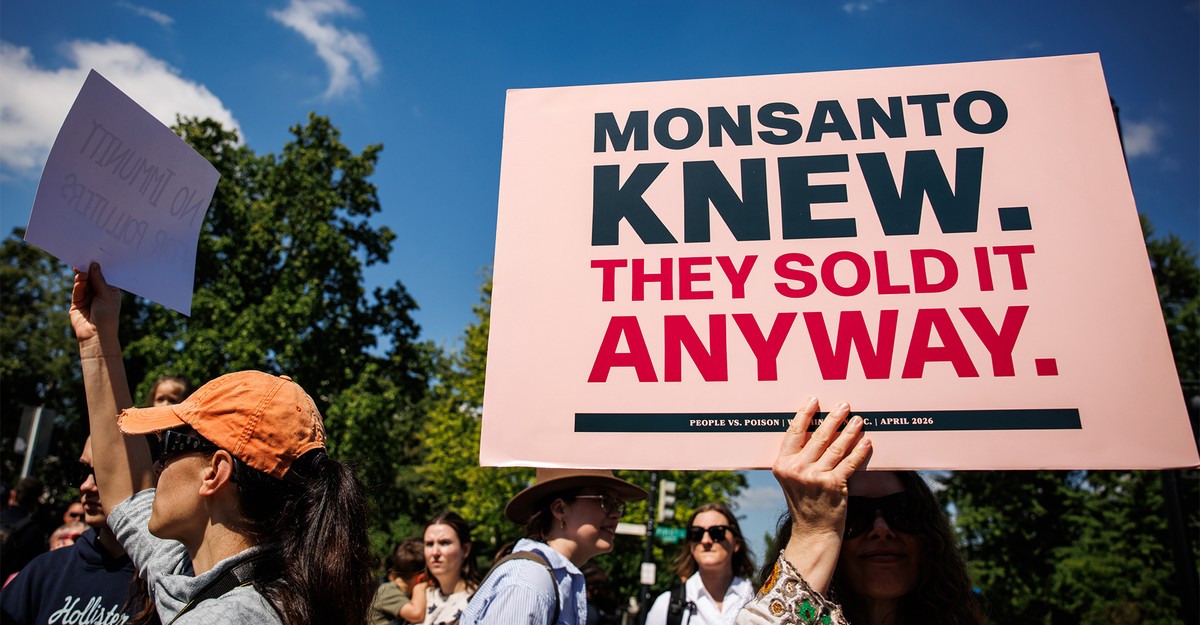
The article centers on the political and legal fight over glyphosate and Roundup, including the Supreme Court case Monsanto v. Durnell and possible federal limits on pesticide liability. It highlights a MAHA rally pressuring the Trump administration after an executive order to boost domestic glyphosate production and ahead of the House Farm Bill vote. The piece is primarily about domestic politics and regulatory risk rather than immediate company fundamentals, though it could matter for Bayer and pesticide manufacturers.
The immediate market implication is not the protest itself but the accelerating politicization of pesticide liability. If MAHA successfully reframes glyphosate as a consumer-safety and “family values” issue rather than an anti-science fringe cause, the overhang shifts from reputational noise to a slower-burning regulatory and litigation discount on the agrochemical complex. That argues for a higher probability of headline-driven multiple compression in crop-input names, even if near-term earnings are unchanged.
The bigger second-order effect is on policy optionality. Any White House attempt to keep the MAHA coalition engaged by softening rhetoric on food additives, pesticides, or farm-bill liability could embolden plaintiffs’ attorneys and state AGs, even without federal rule changes. Conversely, if the administration doubles down on domestic production and preemption, it may help volume economics for U.S.-based manufacturers while worsening the optics of “regulatory capture,” which can keep the litigation bid alive for years.
The contrarian miss is that this may be more useful politically than economically. Glyphosate is a clean wedge issue for MAHA because it unites anti-corporate populists and conventional environmentalists, but that does not automatically translate into a durable legislative coalition. The crowd size and the movement’s current dependence on a few media personalities suggest the signal may be stronger in Washington than in consumer behavior; the market is likely to overestimate the near-term probability of a sweeping federal restriction.
For HHS, the trade is mostly about management of the MAHA brand: if Kennedy is steered toward food/health messaging and away from vaccine controversy, HHS becomes a lower-volatility political asset into the midterms. That lowers tail risk for the administration, but it also means the administration has incentive to keep feeding symbolic wins to the coalition, making this issue more persistent than a one-day protest would imply.
AI-powered research, real-time alerts, and portfolio analytics for institutional investors.
Request DemoOverall Sentiment
neutral
Sentiment Score
0.05
Ticker Sentiment
