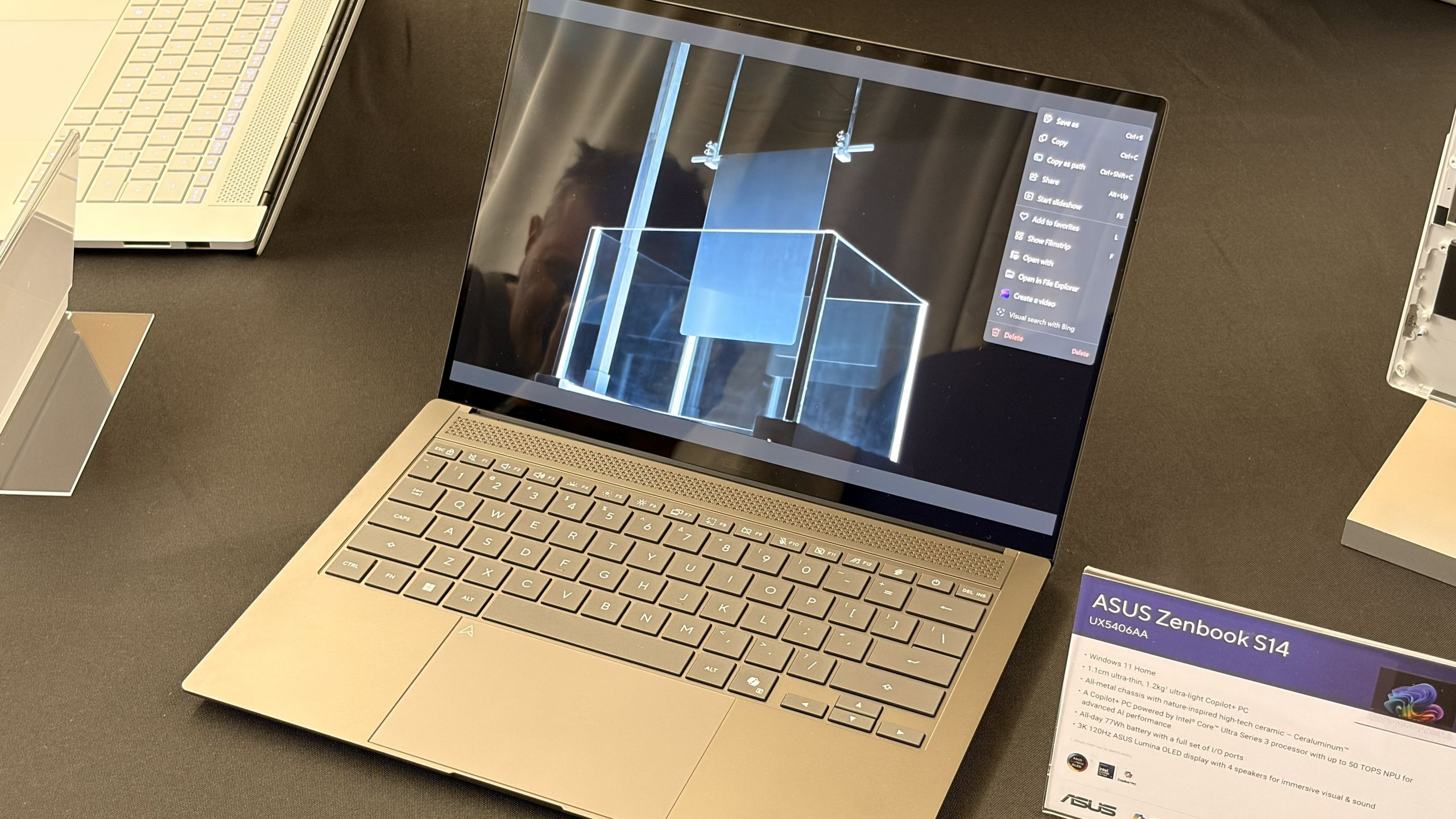
ASUS refreshed its flagship ZenBook S14 and S16 for 2026, shipping the S14 with Intel Core Ultra Series 3 (up to X9/X7 variants) and 50+ TOPS NPUs and the S16 with AMD Ryzen AI 400-series CPUs and 55+ TOPS XDNA NPUs; both are Copilot+ capable, offer 14"/16" 3K 120Hz 16:10 OLED touch displays (1100 nits HDR peak), up to 32GB LPDDR5X on board and 1TB PCIe 4.0 SSD, and 77Wh/83Wh batteries respectively. ASUS did not disclose pricing and warned industry-wide RAM shortages may push prices higher this year, suggesting upside to ASPs but potential margin/volume risks; the refresh is product-positive but is unlikely to be materially market-moving absent pricing or supply visibility.
Market structure: ASUS's use of Intel Core Ultra Series 3 and AMD Ryzen AI 400 in flagship ZenBook S14/S16 is a direct demand read for both INTC and AMD in premium mobile. Expect modest ASP support for OEMs if RAM costs are passed through; memory suppliers (e.g., MU) stand to benefit with a 6–12 month lag if OEMs confirm higher BOMs and shipments stay flat-to-up. Integrated NPUs (50+ TOPS) shift some graphics/AI inference demand away from discrete GPUs in thin-and-light laptops, pressuring low-end mobile dGPU volumes by an estimated 5–15% over 12–18 months.
Risk assessment: Key tail risks include a rapid easing of RAM shortages (negative for MU), software underutilization of integrated NPUs (slower AI feature adoption), or OEM price elasticity triggering volume drops >10%. Near-term (days–weeks) reaction should be muted; short-term (quarters) depends on supply-chain confirmations; long-term (12–24 months) depends on Windows Copilot+ ecosystem uptake and developer support. Monitor OEM channel checks, NAND/DRAM price indices, and Microsoft Copilot OEM partnerships over the next 30–90 days as primary catalysts.
Trade implications: Favor asymmetric, defined-risk exposure to INTC to play mobile CPU wins (3–6 month horizon) and selective LEAPS in AMD for secular AI compute exposure (6–12 months). Use memory suppliers (MU) as a cyclical play sized for 1–2% portfolio exposure; avoid big longs in consumer retail dependent on elastic demand. Option structures (call spreads, LEAPS) reduce downside if laptop volume disappoints.
Contrarian angles: Consensus overlooks that premium OEM price increases can lift margins for chip suppliers but compress unit growth if consumers delay upgrades—creating a narrow window (next 2–4 quarters) where suppliers out-earn OEMs. The market may underprice the stickiness of integrated NPUs; if software rapidly leverages NPUs, mobile SoC vendors capture share from discrete GPU vendors faster than consensus expects, creating opportunities to rotate away from niche mobile dGPU plays into INTC/AMD and memory names.
AI-powered research, real-time alerts, and portfolio analytics for institutional investors.
Request DemoOverall Sentiment
mildly positive
Sentiment Score
0.30
Ticker Sentiment
