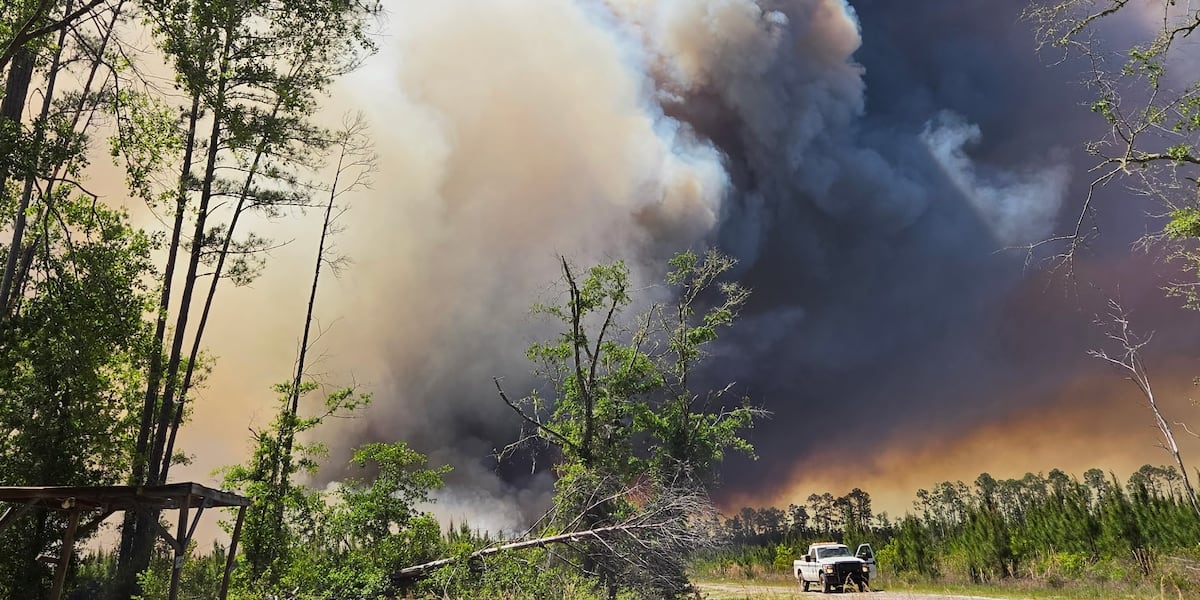
Georgia officials responded to 15 new wildfires statewide, excluding the Pineland Road and Highway 82 fires that have already burned about 53,000 acres combined in southeast Georgia. The Pineland Road Fire has burned over 32,003 acres and is only about 10% contained, while the Highway 82 Fire has burned around 20,933 acres, destroyed dozens of homes, and triggered evacuations and school closures. With strong winds and no significant rain forecast, authorities are urging residents to avoid the area and not fly drones near active fires.
This is a local-weather headline with broader micro impacts than the market usually prices: the first-order cost is property loss, but the second-order effect is a temporary shock to rural logistics, timber operations, and insurance reserve assumptions across the Southeast. In fire-prone timber regions, wind-driven spread and no-rain windows tend to extend disruption beyond the burn perimeter, because road closures, worker absenteeism, and utility interruptions keep mills, harvest schedules, and trucking networks impaired even after containment improves.
The cleaner tradeable implication is less about broad-market beta and more about regional beneficiaries and casualties. Homeowners and small businesses in the affected corridor likely create an immediate claims pulse for P&C carriers with Georgia exposure, while specialty carriers and reinsurers face a near-term loss-estimate reset if additional acreage or structure losses spike. Conversely, companies tied to wildfire suppression, emergency housing, temporary power restoration, debris removal, and telecom restoration can see modest but real demand uplift over the next 1-4 weeks as evacuee support and infrastructure repair scale.
There is also a commodity angle that is easy to miss: if the fires persist, sawtimber and pulpwood supply in the Southeast can tighten at the margin, supporting local stumpage pricing even as near-term harvest volumes are disrupted. That matters most for producers with exposed mill feedstock or timberland valuation sensitivity; the more immediate risk is to logging contractors and regional rail/trucking volumes, not the large-cap forest products names, which can often reroute inventory and draw on broader procurement networks.
The main contrarian point is that the market may overestimate the durability of the shock if rain arrives or containment accelerates; wildfire claims often compress into a short reporting window, then fade unless there is a major structural loss event. The better risk/reward is to express a one-to-four week event trade rather than a secular thesis: the upside is acute but time-bounded, while the downside is that sentiment snaps back quickly once the fire map stops expanding.
AI-powered research, real-time alerts, and portfolio analytics for institutional investors.
Request DemoOverall Sentiment
moderately negative
Sentiment Score
-0.42
