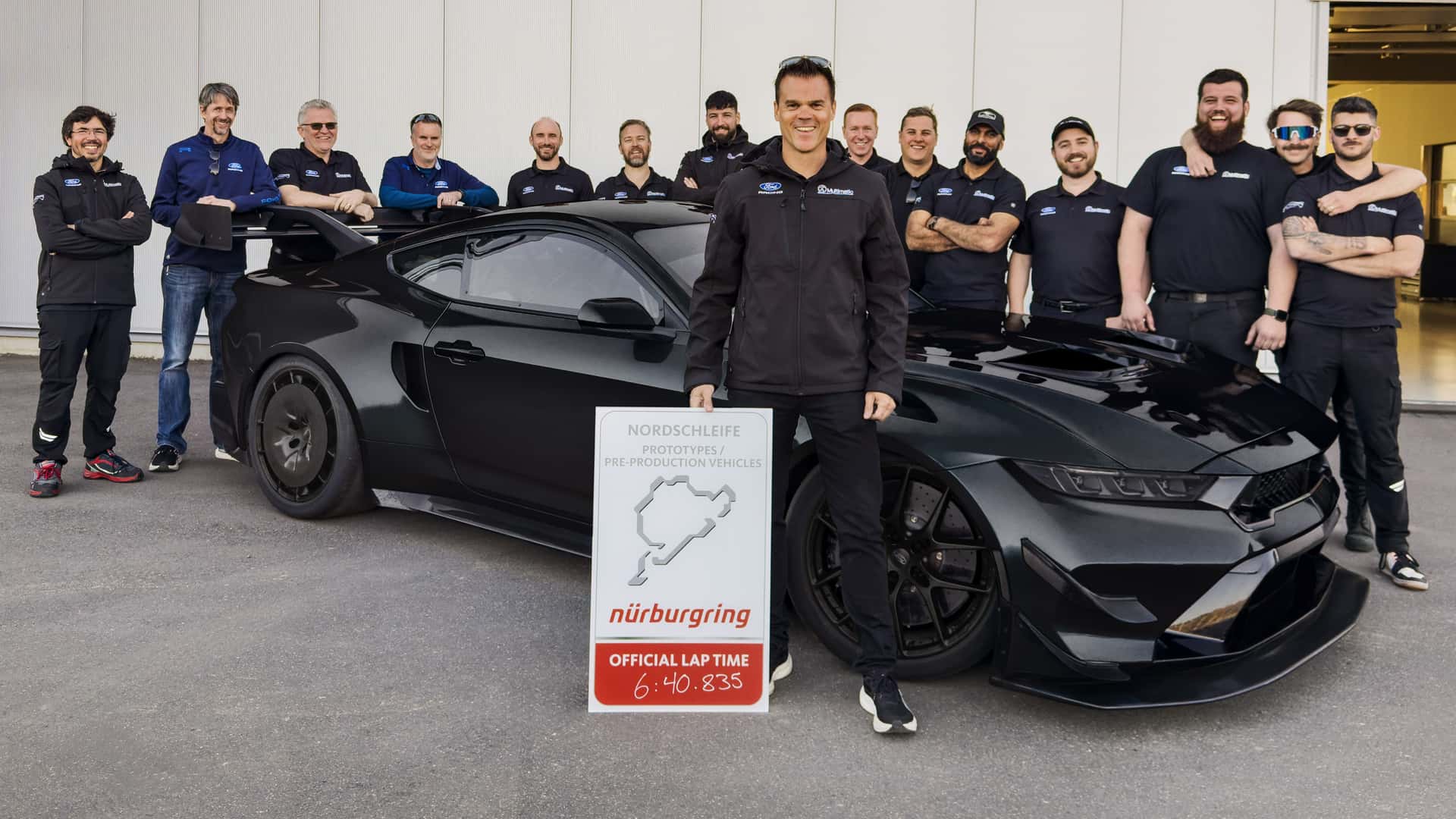
Ford’s Mustang GTD Competition set a new Nürburgring lap record for American street-legal cars at 6:40.835, beating the Corvette ZR1X by more than 8 seconds and improving on the previous Mustang GTD best by 11 seconds. The upgraded model adds more power, lighter components, revised aero, and new tires, with Ford planning a limited serialized production run. The news is positive for Ford’s performance brand and halo vehicle positioning, but the likely market impact is limited given the niche volume.
Ford is using halo-product performance as a capital-allocation tool: the GTD program is less about direct unit volume and more about re-rating the Mustang nameplate, price architecture, and dealership traffic. The meaningful second-order effect is that each headline lap improvement strengthens Ford’s ability to extract margin from low-volume, high-gross-margin specials while reinforcing the broader performance franchise at a time when mainstream ICE demand is structurally challenged. That matters more for investor psychology than for near-term EPS, but it is exactly the kind of brand equity compounding that can support a better mix over the next 12-24 months.
The competitive read-through is not that Ford suddenly “wins” against Chevrolet on an absolute basis; it’s that GM’s Corvette halo is now less unique, and Ford has shown it can keep pace with a much lower-volume, more bespoke execution model. If this turns into a recurring ladder of record-setting variants, the real beneficiary is the supplier ecosystem around carbon aero, lightweight materials, tires, and low-volume performance tooling, because those components become more reusable across niche performance programs. The loser is any OEM relying on the Corvette as a standalone brand-defining moat.
The contrarian point is that this is close to a demand ceiling story, not a mass-market growth story. At this price tier, incremental lap-time gains are mostly a branding exercise, and the economic value depends on how many serialized units Ford can actually monetize without diluting the Mustang mainstream image. Near term, the stock reaction should be modest unless Ford pairs the announcement with evidence of higher-order book quality, stronger dealer allocation economics, or pricing power in performance trims. Over months, the more important catalyst is whether Ford can translate halo hype into better transaction prices on the broader Mustang lineup and adjacent performance accessories.
AI-powered research, real-time alerts, and portfolio analytics for institutional investors.
Request TrialOverall Sentiment
mildly positive
Sentiment Score
0.35
Ticker Sentiment
