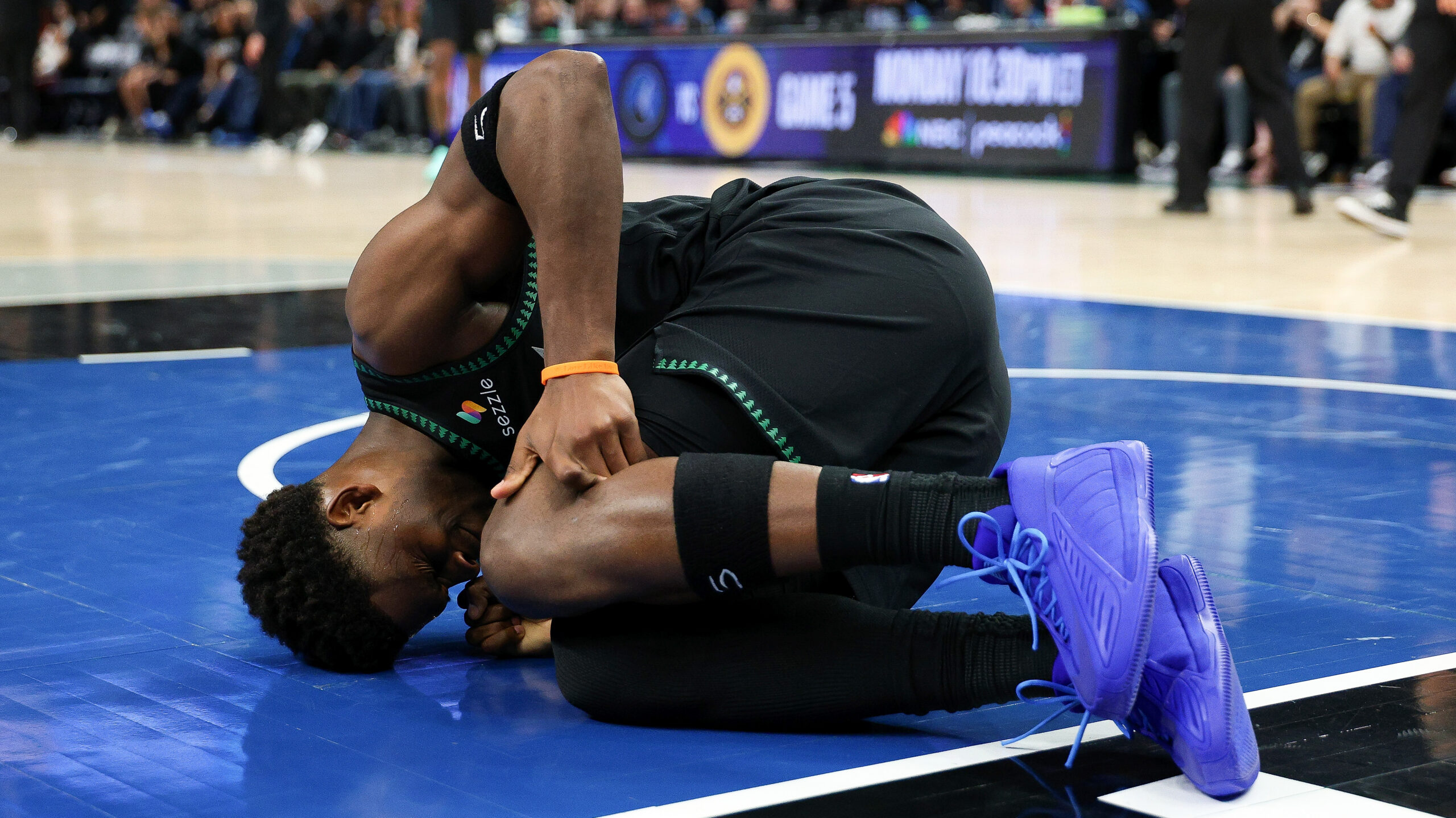
Donte DiVincenzo’s season is over with an Achilles tendon injury, while Anthony Edwards’ left knee injury remains uncertain after both guards exited Minnesota’s Game 4 win over Denver. Edwards was ruled out after his knee buckled late in the second quarter, and DiVincenzo left the arena in a wheelchair. The Timberwolves still won 3-1 to take control of the Western Conference quarterfinal series.
The market impact here is less about one playoff result and more about how quickly a two-man guard rotation can become a structural handicap in a short series. In the near term, Minnesota’s ball-handling depth, transition pace, and half-court shot quality are the real vulnerabilities; the second-order effect is that the team’s offensive burden shifts disproportionately onto shot creation from one primary scorer, which tends to compress possession efficiency and raise turnover risk. That usually shows up immediately in Game 5 pricing, but the larger edge is on any market that is still discounting injury volatility in a series with little time for tactical adjustment.
For the opponent, the loss of perimeter creators can create a misleadingly small scoreboard gap while still improving the underlying win probability. Teams can survive one injured creator, but two changes the defensive math: stronger nail help, more aggressive top-locking, and more help-off-the-corner coverages become viable because the remaining handlers are forced into lower-value possessions. Over a 3-7 day horizon, this tends to favor the healthier team and any derivative exposure tied to advance probabilities rather than single-game scoring margins.
The contrarian angle is that the knee concern may be more important for pricing than the clearly catastrophic leg injury, because an uncertain timeline creates the widest variance in series outcomes. If the knee issue is minor, the market may overreact on headline risk and overstate the probability of a long-term collapse; if it is structural, the series can flip from a competitive market to a near-term blowout in one injury report cycle. That makes the best risk/reward setup event-driven rather than directional: trade the information gap, not the public emotion.
AI-powered research, real-time alerts, and portfolio analytics for institutional investors.
Request DemoOverall Sentiment
moderately negative
Sentiment Score
-0.45
