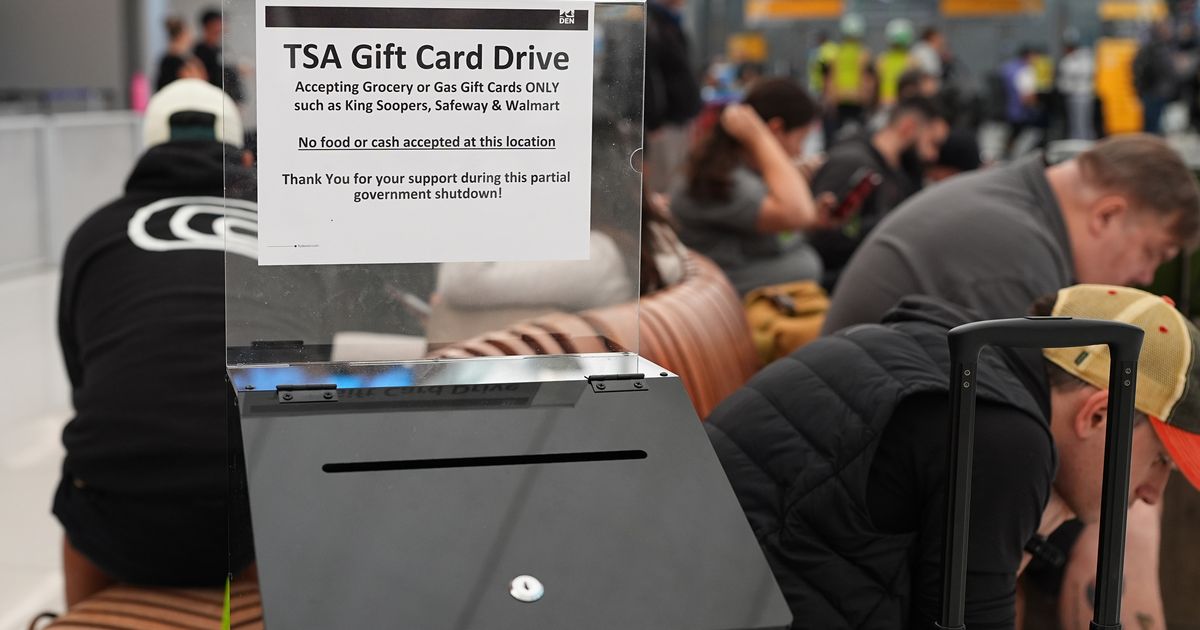
The Department of Homeland Security partial shutdown entered its 36th day, leaving ~120,000 DHS employees working without pay, including roughly 50,000 TSA officers. Nonprofits and airport communities have stepped in with targeted aid (e.g., 400 food boxes, ~$20 per bag; roughly $6,000 in cash/gift cards plus ~$10,000 in food/product donations at one airport), coordinating with unions and airports due to federal gift rules. The situation is primarily a humanitarian and operational strain on airport staffing rather than a direct market-moving event, though prolonged funding lapses could exacerbate labor and passenger-service disruptions.
The visible band‑aid of charities and airport tenant donations masks a deeper liquidity mismatch that will play out over weeks: individuals who miss paychecks cut discretionary spending first, compressing non‑ticket airport revenue (concessions, parking, retail) by an incremental 5–10% per week of payroll disruption in airports with high DHS staffing. That ripple is asymmetric — concession operators with thin margins and short payment cycles (small vendors, regional operators) face immediate cash‑flow strain and higher working capital need, while large integrated suppliers and outsourced security contractors absorb fixed costs and become natural takeover targets. Over a 3–12 month horizon, repeated shutdowns materially increase the probability (currently non‑trivial given election cycle incentives) of accelerated capital allocation toward automation/biometrics and third‑party screening contractors; budget re‑prioritization favors CAPEX for throughput over labor‑intensive models, shifting economics away from hourly labor to technology and contractor suppliers.
Catalysts and tail risks are concentrated: a rapid shutdown resolution (days) materially reduces near‑term travel disruption risk but leaves the structural shift unchanged; a prolonged 30–90 day lapse elevates airline operating disruptions, forces overtime payments, and forces some vendors into default. Political calendar risk (funding negotiations tied to high‑visibility law‑and‑order topics) means the event can reoccur with ~12–24 month periodicity around election cycles, making technology vendors and large contractors beneficiaries on a multi‑quarter basis. Reversal triggers include emergency federal pay authorizations, targeted stopgap bills for DHS payroll, or union‑led walkouts which would flip outcomes within days to weeks and create short squeezes in affected names.
Near‑term operational readouts will be more informative than headlines: monitor airport concession revenues, TSA call‑outs and overtime hours, and union hardship fund flows — each will lead the credit stress signal for small vendors and regional payroll‑exposed banks. For investors this is a liquidity‑and‑policy story not a demand shock; winners are firms with balance sheets that can capture outsourced screening contracts or sell automation hardware/software, while losers are small concession operators, short‑duration tickets on regional carriers with weak liquidity, and locally focused lenders with concentrated DHS employee deposits.
AI-powered research, real-time alerts, and portfolio analytics for institutional investors.
Request DemoOverall Sentiment
mildly negative
Sentiment Score
-0.25
