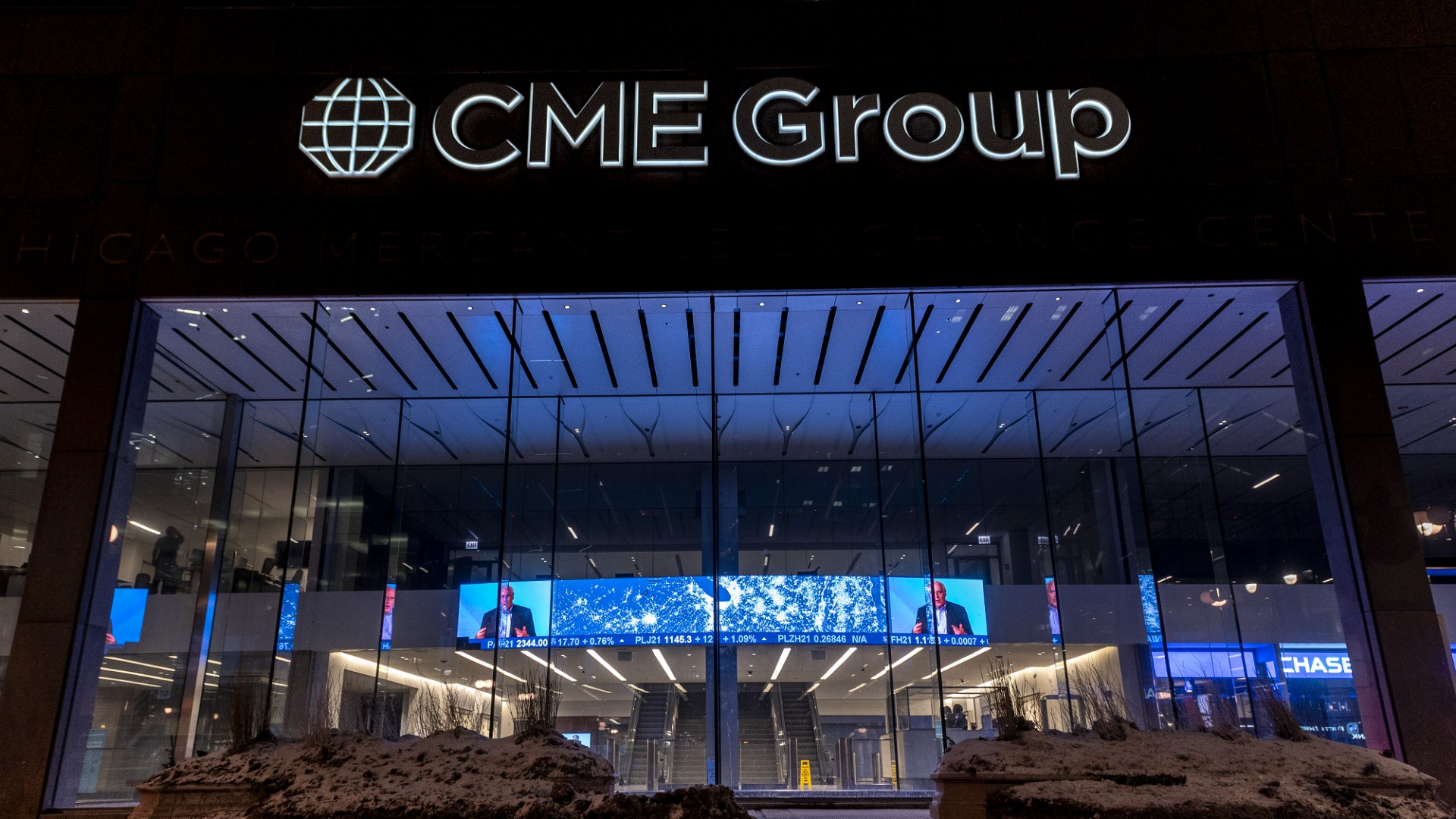
A CME trading outage, now largely resolved, appears linked to a cooling/data‑center issue possibly exacerbated by skeletal staffing around the Thanksgiving period; the exchange has engaged data‑center operators and internal committees. Traders reported some will exploit price dislocations while many paused trading amid month‑end flows and options expiry, with European spreads widening briefly but liquidity preventing broader contagion; US futures were slightly higher and Treasuries remained steady. Hedge funds should monitor residual execution risk and potential arbitrage opportunities amid low holiday liquidity, and expect follow‑up details and possible operational fixes or guidance from the exchange.
Market structure: The outage is a direct negative for CME Group (CME) — clients who prioritize operational resilience (large asset managers, HFTs, prop shops) are potential winners if they migrate to ICE (ICE) or CBOE (CBOE). Expect a measurable, but likely modest, flow transfer: assume 1–3% of high-frequency/clearing volume could reprice to competitors over 3–12 months if SLA improvements are not rapid, pressuring CME’s fee-based EBITDA growth by ~50–150 bps. Liquidity providers will widen quoted spreads in thin windows (e.g., U.S. holidays), increasing transaction cost curves across listed derivatives.
Risk assessment: Tail risks include a regulatory enforcement action (fines/mandated remediation) and contractual client migration accelerating if a repeat outage occurs; probability 10–20% over 12 months but >$200m financial/reputational hit to CME in a severe scenario. Near-term (days) the main risk is volatility and basis mispricing around options expiries; medium-term (3–6 months) is share loss and fee compression; long-term (12+ months) is higher capex for redundancy. Hidden dependency: third-party data center operators and staffing patterns during holidays — a repeat correlated failure could catalyze outsized client exits.
Trade implications: Tactical: favor short-duration hedges around expiries — buy 3–7 day SPX/ES put spreads to protect delta exposure during thin liquidity windows; cost target <0.5% premium of notional. Structural: initiate a modest relative position (long ICE, short CME) sized 2–3% NAV, using 3–9 month options to cap downside; this captures potential 1–2% annualized revenue share shift. Avoid adding outright long CME exposure until 90–180 days of demonstrable remediation (measured by uptime SLAs >99.99% across two holiday cycles).
Contrarian angles: Consensus focuses on operational blame and short-term flow loss; market may underprice CME’s switching costs (clearing relationships, margination, client stickiness) — downside could be limited if CME completes rapid remediation. Reaction may be overdone if CME quickly commits $100–300m capex and publishes third-party audit within 30–60 days; conversely, complacency is risky if vendors are opaque. Historical parallel: 2010 flash-crash exchange outages produced temporary share dips but long-term incumbents recovered after improvements; use 3–9 month event window, not binary judgment.
AI-powered research, real-time alerts, and portfolio analytics for institutional investors.
Request DemoOverall Sentiment
mildly negative
Sentiment Score
-0.25
Ticker Sentiment
