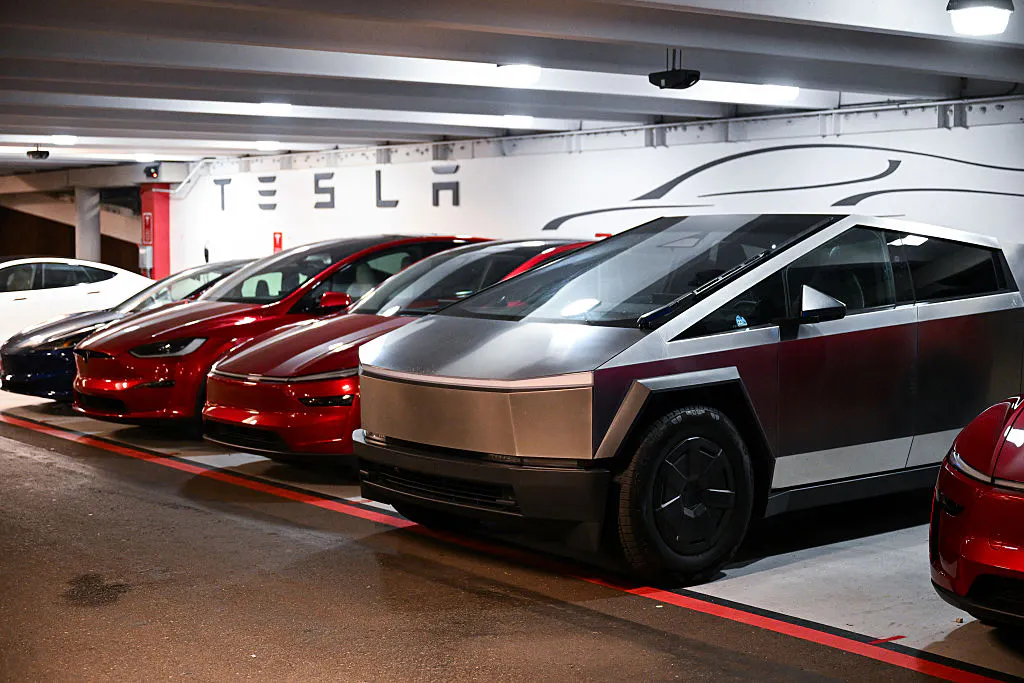
Tesla enters Wednesday's Q1 earnings with Wall Street expecting revenue of $22.3B (+15% y/y), EPS of $0.36, and free cash flow of -$1.4B. The article highlights pressure from lower regulatory credit revenue, pricing cuts to clear inventory, and rising capex that could reach a record $20B, all of which could weigh on margins and cash flow. Investors are also focused on longer-term Robotaxi and Optimus progress, with Robotaxi now in four markets and a nine-market target by the first half of the year.
The key issue is not the quarter, but the sequencing problem: Tesla is trying to fund an AI/robotics option set while its core auto engine is still absorbing price cuts, inventory normalization, and capex intensity. That combination is hostile to equity duration because it forces the market to underwrite growth today with diminishing cash generation, while the payoff from autonomy remains highly path-dependent and likely years out. In the near term, any disappointment on margins or cash flow can compress multiple expansion faster than headline delivery growth can offset it.
The second-order winners are the legacy EV and hybrid franchises that do not need to spend as aggressively to preserve unit economics. If Tesla keeps leaning on price to sustain volume, it effectively subsidizes share gains for competitors with more stable ASPs and less volatile capex, especially OEMs with improving EV mix but stronger ICE profit buffers. On the supply chain side, softer Tesla demand for battery materials and high-value components could briefly pressure upstream pricing, but that benefit is more likely to accrue to competitors via lower input costs than to Tesla via margin relief.
The market is likely underestimating how sensitive the stock is to “free cash flow credibility” rather than GAAP earnings this year. A continued miss on FCF does not just matter for valuation; it constrains the company’s ability to self-fund autonomy and manufacturing retooling without increasing external financing risk or slowing investment. The catalyst path is asymmetric: a clean margin print with better-than-feared cash burn could squeeze shorts for days, but a reaffirmation of aggressive capex alongside weak automotive economics could re-rate the name lower over the next several months.
The contrarian view is that investors may be over-anchored to automotive weakness and underpricing the optionality from energy, services, and software leverage if Tesla can prove those segments are becoming structurally more important to the mix. If management can show that newer businesses are compounding faster than car margins are eroding, the market may be willing to look through near-term FCF pressure. But that requires evidence, not narrative, and the burden of proof is high after the delivery miss.
AI-powered research, real-time alerts, and portfolio analytics for institutional investors.
Request DemoOverall Sentiment
moderately negative
Sentiment Score
-0.35
Ticker Sentiment
