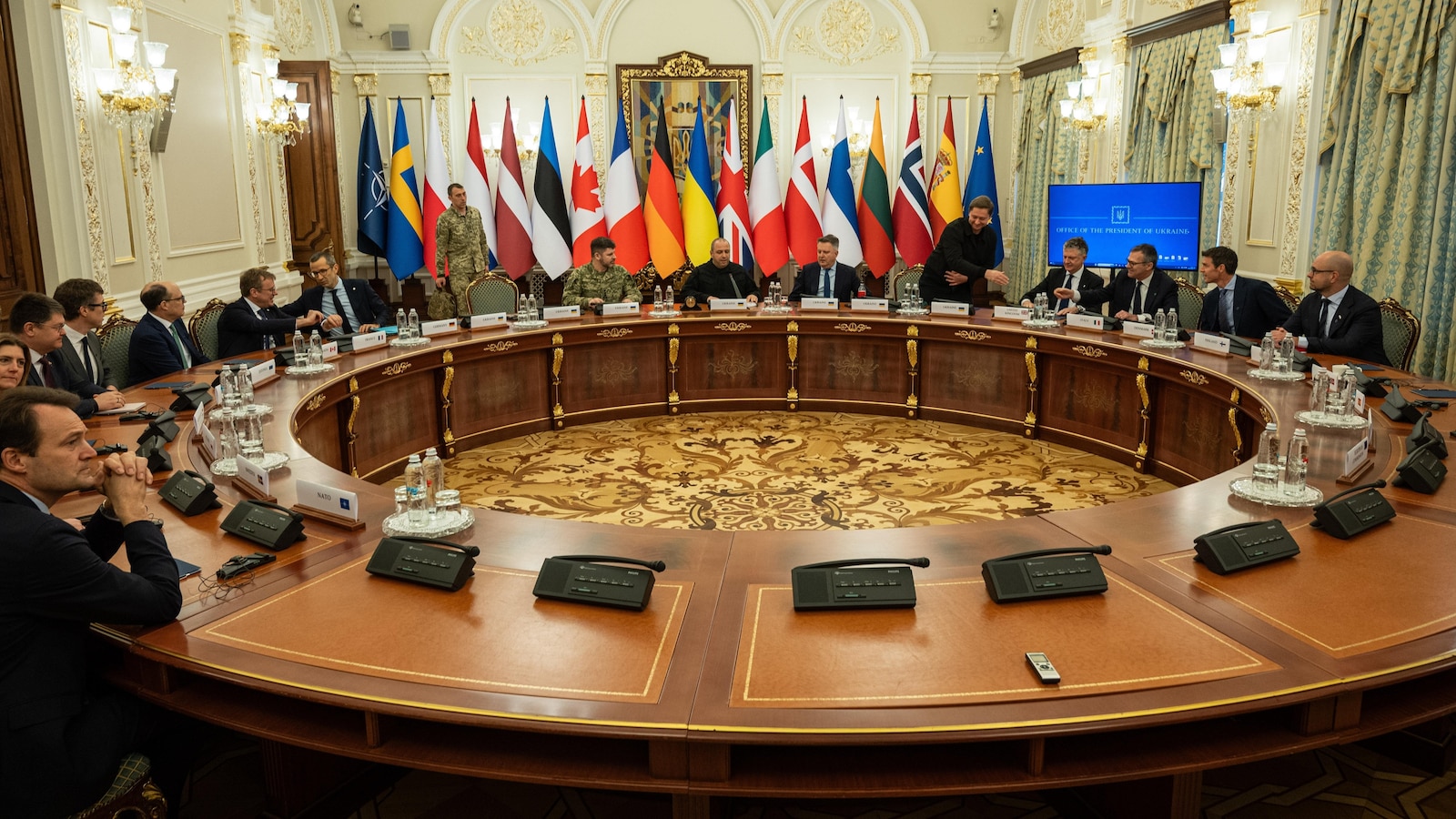
European national security advisers, joined by representatives from Canada and NATO, met in Kyiv to coordinate a U.S.-led diplomatic push and security-guarantee framework that envisages Ukrainian forces as the first line of defense, European-led troop deployments in Ukraine and an American ‘backstop’. President Zelenskyy is convening leaders from about 30 countries in Paris next week as part of a ‘Coalition of the Willing’; domestically he appointed Gen. Kyrylo Budanov as chief of staff to sharpen security and diplomacy efforts. The talks come amid ongoing Russian strikes—recent missile and drone attacks in Kharkiv and Mykolaiv caused civilian casualties and infrastructure outages—maintaining geopolitical risk and market uncertainty for investors.
Market structure: The immediate winners are large defense primes (LMT, RTX, NOC, GD, LHX) and European defence contractors (BA.L, AIR.PA) plus suppliers of steel, copper and heavy machinery (CAT, FCX) as multi‑year security guarantees and European troop deployments imply sustained procurement and reconstruction demand. Losers include Russian assets and commodity logistics exposed to sanctions; pricing power should favor primes with order backlogs but delivery lead times (12–36 months) will constrain revenue recognition. Cross‑asset effects: short‑term risk‑off could bid Treasuries and gold higher, while a credible peace framework would gradually pressure risk premia and push yields up over 3–12 months; industrial commodities could rise 10–25% over 6–18 months if reconstruction accelerates.
Risk assessment: Tail risks include direct NATO–Russia military escalation (low probability, extreme drawdown) and US Congress failing to approve supplemental aid (medium probability, immediate market shock). Near term (days) expect 5–15% headline-driven volatility in defense names around the Paris summit; short term (weeks–months) watch for contract announcements that can move single stocks 10–30%; long term (quarters–years) anticipate 5–10% CAGR uplift to defence sector revenues if multilateral guarantees are formalized. Hidden dependencies: supply‑chain chokepoints (semiconductors, precision metals), export controls, and domestic EU politics could blunt procurement timelines.
Trade implications: Direct plays — overweight large-cap defense (LMT, RTX), materials (CAT, FCX) and an aerospace & defence ETF (ITA) while hedging geopolitical tail risk with index puts. Options: use 30–60 day call spreads on ITA/LMT around the summit to capture upside while capping premium; buy short-dated SPY puts for downside insurance. Sector rotation: increase allocation to Industrials/Materials/Defence by +3–6% of portfolio over 1–12 months and reduce cyclicals vulnerable to European energy disruption.
AI-powered research, real-time alerts, and portfolio analytics for institutional investors.
Request DemoOverall Sentiment
mixed
Sentiment Score
-0.05
Contrarian angles: The market may underprice a scenario where “peace” accelerates formal EU/NATO spending commitments—paradoxically increasing near‑term defense orders to lock capability. History (post‑2014) shows that geopolitical de‑escalation rhetoric often precedes multi‑year procurement increases; short-term dips on optimistic headlines are buying opportunities. Unintended consequence: accelerated procurement can create margin pressure and capex seasonal swings—favor balance‑sheet strong primes with >2 years backlog.
