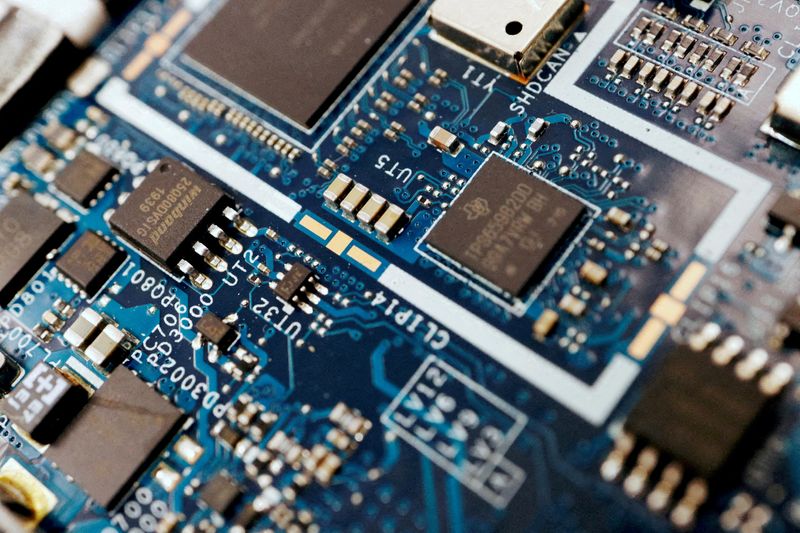
Taiwan’s stock market has reached nearly $4.3 trillion, surpassing the UK, while South Korea is just $140 billion behind as AI-driven semiconductor demand lifts both markets. TSMC, Samsung Electronics, and SK Hynix are the key beneficiaries, with investors treating North Asian chip supply chains as core AI infrastructure plays. The article is broadly constructive for memory and semiconductor stocks, though it is mainly commentary rather than a new catalyst.
The important second-order effect is that this is no longer just an AI-equity story in the US; it is turning into a capital-allocation regime where the highest-beta way to express AI exposure is through North Asian industrial plumbing. That matters because the incremental dollar of AI capex is likely to propagate first into advanced foundry and memory suppliers before it shows up in application-layer winners, which should keep earnings revisions strongest for TSM and, to a lesser extent, the memory complex. The market is effectively pricing a multi-year scarcity premium for capacity, process leadership, and packaging bottlenecks, not just generic AI demand.
The more interesting setup is that memory is transitioning from a cyclical commodity trade into a quasi-structural lever on AI buildout. If hyperscaler capex remains elevated, DRAM and HBM pricing power can persist longer than the market typically allows, which should compress the usual boom-bust cadence and raise the floor on valuation multiples. That creates a potential spread trade: the beneficiaries are not only the headline chip designers, but also the underappreciated upstream suppliers whose earnings are still early in the revision cycle.
The main risk is not demand collapse; it is supply response and positioning. A few quarters of high pricing can trigger wafer-capacity additions, subsidy-backed competition, and inventory normalization, which would hit the memory names faster than TSM because memory has fewer structural moats and a more visible cycle. A second-order macro risk is currency and geopolitical stress: if the Taiwan/Korea equity rerating becomes too crowded, any exogenous shock could force de-risking even while fundamental demand stays intact.
Consensus likely still underestimates how much of the AI trade can be expressed through Korea/Taiwan equity beta rather than just NVDA. The move may be only partially overdone because index-level leadership is still narrow, but the cleaner opportunity is to own the supply chain where revisions are accelerating, not the most obvious AI brand names. Over the next 3-9 months, this looks like a relative-value and momentum trade more than a broad market call.
AI-powered research, real-time alerts, and portfolio analytics for institutional investors.
Request DemoOverall Sentiment
moderately positive
Sentiment Score
0.45
Ticker Sentiment
