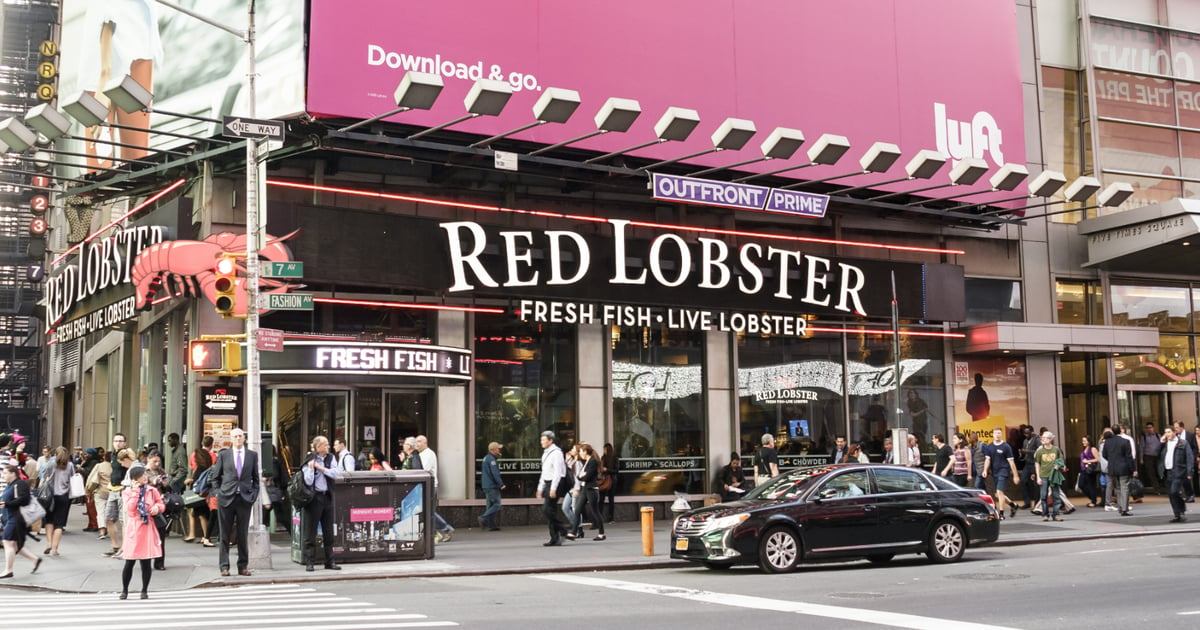
Red Lobster will close its Times Square flagship on June 14 after 23 years, citing construction-related traffic losses that made the site economically unsustainable. The closure comes as the chain continues to rightsize after Chapter 11, with more than 100 store closures over recent years and 2025 U.S. sales down 6.2% to $1.56 billion. The news is negative for Red Lobster but likely limited in broader market impact.
The key signal is not the closure itself; it is that weak traffic is now forcing brands to rationalize premium flagship real estate that was previously justified as marketing spend. That implies a broader pressure on unit economics across casual dining: rent leverage is breaking, and operators with high occupancy costs or legacy urban footprints will need to choose between margin defense and relevance. The immediate winners are off-premise-heavy concepts and value platforms with lower fixed-cost intensity, because traffic migration away from destination dining tends to redistribute spend toward convenience and price, not necessarily away from the category entirely.
Second-order effects should show up in the supply chain before headline sales data do. Lower dine-in traffic reduces premium seafood and labor demand, which is negative for distributors and for landlord economics in tertiary urban assets that depend on experiential tenants to support footfall. The housing conversion angle matters: as office-to-residential projects remove daytime traffic but add more stable evening demand, the transition period can be a multi-quarter dead zone for adjacent restaurants, creating a lagged drag on nearby operators that the market will likely underappreciate.
The market’s likely consensus is that this is an idiosyncratic post-bankruptcy cleanup. I think that is too narrow. The more important read-through is that even recognizably strong consumer brands can no longer count on brand equity to offset slower traffic and inflation-fatigued consumers, which raises the odds of more closures, more refranchising, and heavier promotional spend over the next 6-12 months. Any improvement likely requires either a material consumer rebound or a reset in value perception across casual dining; absent that, the operating backdrop remains structurally hostile.
Contrarianly, the overreaction risk is that investors extrapolate these closures into an outright collapse in all restaurants, when the dispersion is widening rather than the category uniformly deteriorating. Coffee, beverages, snacks and chicken still have enough frequency and price elasticity to take share, so the better trade is to own the winners of value and convenience while fading legacy dine-in exposure. The main catalyst to reverse the negative setup would be a sustained real-wage pickup or aggressive menu pricing resets that restore traffic without compressing margins, but that looks more like a 2H26 story than a near-term fix.
AI-powered research, real-time alerts, and portfolio analytics for institutional investors.
Request TrialOverall Sentiment
moderately negative
Sentiment Score
-0.45
