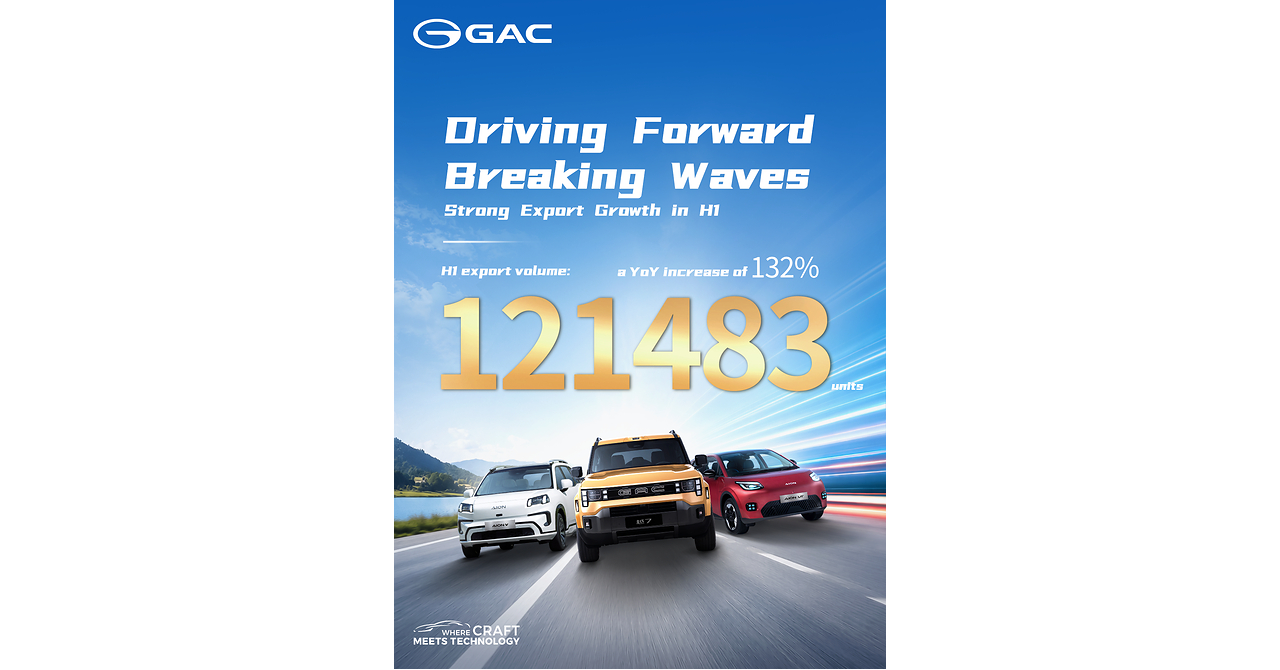
GAC International reported first-half 2026 exports of 121,483 units, nearly matching last year’s full-year total, with exports up 132% year-on-year. Overseas wholesale and end-user retail volumes doubled YoY, alongside major regional gains in the Americas, Asia-Pacific, Europe, and Middle East/Africa. The AION UT expanded production in Austria and debuted across multiple European markets, while the AION UT and AION V delivered several No.1 sales and residual-value awards, supporting a notably upbeat growth narrative.
The important read-through is not the unit growth itself, but that Chinese auto exporters are moving from pure shipment arbitrage toward local-market monetization: assembly, dealer networks, residual-value support, and financing penetration. That shifts the competitive battle from product specs to after-sales economics, where incumbents like BYD, Geely, and SAIC can win share if they can keep warranty costs and discounting contained. The second-order winner is the supply chain behind overseas localization — CKD kits, shipping, port handling, local dealer finance, and country-specific homologation — while the loser is any OEM still relying on heavy export discounts without a service footprint.
Near term, the market may overreact to the headline because wholesale growth can be pulled forward by fleet/taxi channels and aggressive pricing, which usually shows up in gross margin 1-2 quarters later. The key catalyst is the next earnings update: if overseas mix rises while export gross margin and inventory days stay stable, the story upgrades from narrative to earnings power. If not, this is just a volume print, and the multiple should not expand much.
The contrarian risk is that investors are underestimating political friction. Local production in Europe helps reduce tariff exposure, but it also invites scrutiny on subsidies, rules-of-origin, and pricing discipline; any EU or country-level anti-subsidy action would hit the thesis within months. Over 6-18 months, the real falsifier is not slower shipments but deteriorating residual values or rising warranty/credit losses, which would cap financing-led adoption even if unit growth stays strong.
AI-powered research, real-time alerts, and portfolio analytics for institutional investors.
Overall Sentiment
strongly positive
Sentiment Score
0.45
Ticker Sentiment
