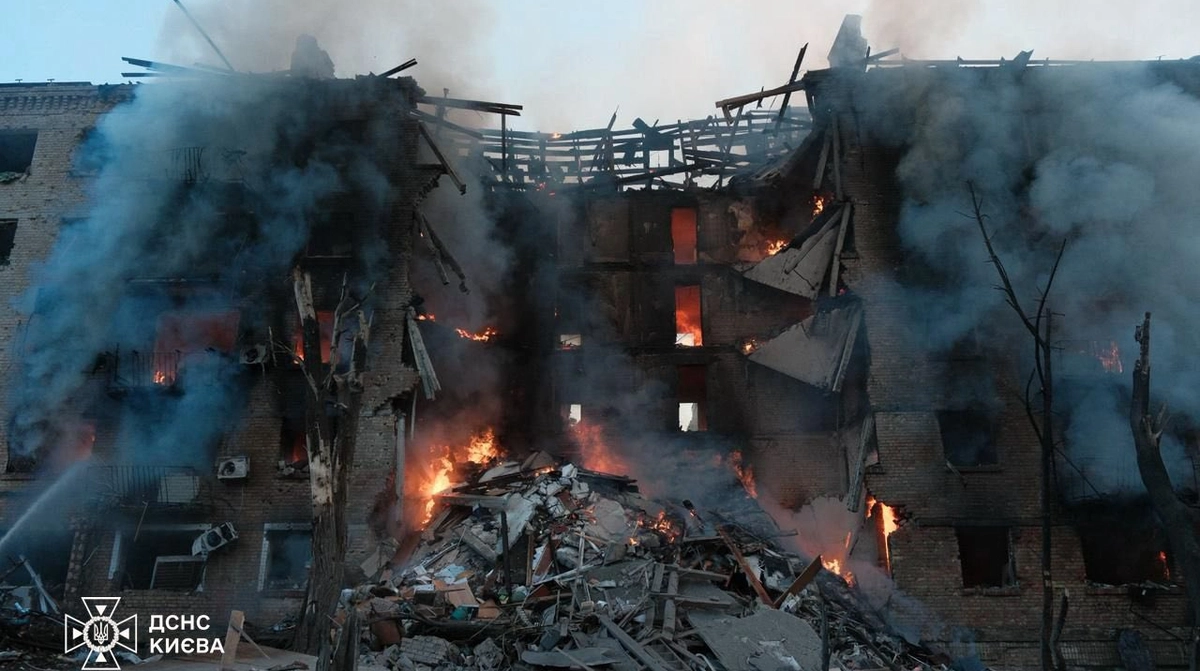
Russia launched ballistic missiles and drones at Kyiv, killing 1 woman and injuring 44 people, including 2 children; 28 were hospitalized and 3 remained in severe condition. Multiple residential buildings, schools, a supermarket, a market area, and a business center were hit across several districts, with fires and structural damage reported. The attack represents a major escalation in geopolitical risk and could have broad regional market implications.
The immediate market read is not about the physical damage itself but about the implied step-up in wartime intensity and the probability of a broader campaign against urban infrastructure. That raises the expected cost of capital for anything tied to Ukrainian reconstruction and elongates the timeline for housing, utilities, telecom, and retail normalization; the second-order hit is to domestic confidence, insurance availability, and labor productivity rather than just one-night destruction.
The most important near-term effect is on air defense economics. Each successful mixed salvo forces Ukraine to spend scarce interceptor inventory on low-cost drones plus higher-cost ballistic threats, which is structurally unfavorable if the attacker can sustain sortie generation. That dynamic matters over days to weeks: if barrage density remains elevated, the market should price a higher probability of emergency Western resupply and faster procurement decisions for layered defense systems, benefiting primes with short-cycle munitions and sensor content.
For equities, the cleaner expression is to avoid broad reconstruction baskets until there is evidence of a durable ceasefire or at least reduced strike intensity. The asymmetric setup is in defense supply chain names with backlog optionality, while localized Eastern Europe property, insurance, and retail exposure should trade with a war-risk discount that can widen abruptly on fresh attacks. A contrarian angle is that headline damage often overstates medium-term macro impact, but the real overhang is not the destruction itself; it is the repeated reset of expected stabilization, which can keep valuation multiples compressed for months.
In duration terms, this is a days-to-weeks catalyst for defense and risk-off positioning, but a months-long drag on reconstruction-linked assets if missile attacks persist. Any sign of successful interdiction of launch platforms or a pause in strike cadence would reverse the defense bid quickly, but absent that, volatility should stay elevated and reconstruction timing risk should widen.
AI-powered research, real-time alerts, and portfolio analytics for institutional investors.
Request DemoOverall Sentiment
extremely negative
Sentiment Score
-0.95
