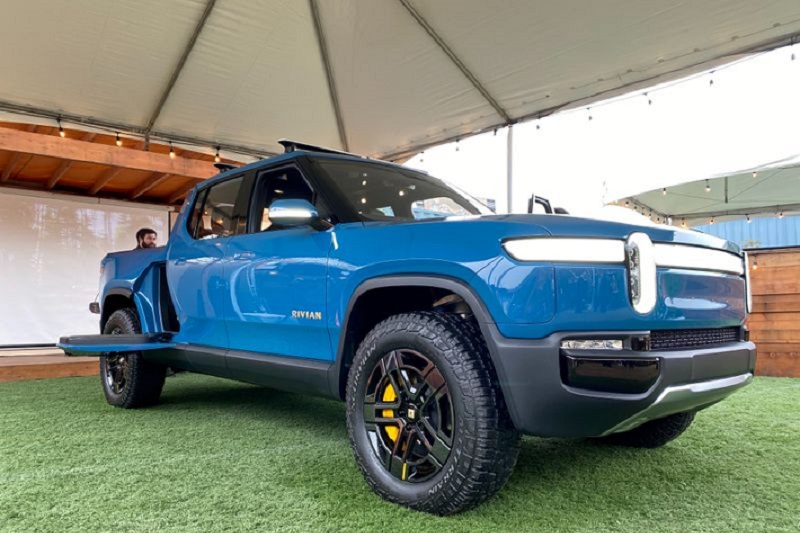
Rivian posted Q1 2026 EPS of -0.33 versus -0.63 expected and revenue of $1.38 billion, while reaffirming FY2026 delivery guidance of 62,000-67,000 vehicles and capex of $1.95 billion-$2.05 billion. Cantor Fitzgerald raised its price target to $19 from $18, and several other analysts reiterated constructive views as R2 production has begun and customer deliveries are expected in the coming weeks. The stock also has multiple funding and partnership catalysts, including Uber's planned investment of up to $1.25 billion and Volkswagen-related capital commitments.
The near-term setup is less about Rivian’s standalone execution and more about whether the market is finally willing to underwrite a multi-year financing bridge. The combination of external capital, a better product cadence, and a higher-visibility commercial relationship with a scaled platform partner lowers the probability of a liquidity crisis, which should compress the equity’s left-tail risk even if earnings remain deeply negative. That matters because in capital-intensive autos, the equity often trades less on next-quarter margins than on whether dilution risk is perceived as manageable over the next 12-24 months.
The second-order winner is Uber, which is effectively buying optionality on differentiated EV supply and future autonomy economics without having to own the manufacturing risk. If the deployment story advances, Uber gets a potential moat in fleet economics and rider acquisition while shifting capex intensity off its own balance sheet; the risk is that the market is now likely to capitalize the partnership too aggressively before regulatory, safety, and unit economics are proven. For Rivian, the strategic value is real, but the path to monetization is long-dated, so any enthusiasm in the stock is vulnerable to a reset if investors focus back on cash burn and gross margin normalization over the next 2-3 quarters.
The contrarian read is that consensus may be underestimating how much of Rivian’s upside is already tied to de-risking events rather than operating leverage. If capital inflows and production milestones continue, the stock can rerate on reduced distress probability even without a clean profitability inflection; however, that rerating ceiling is likely limited until the market sees evidence that incremental volume meaningfully improves gross profit. The most fragile link is execution timing: any slippage in R2 launch, customer delivery ramp, or partner funding cadence would quickly reopen dilution and going-concern fears.
The broader sector implication is modestly negative for legacy OEMs and emerging EV competitors that lack strategic partners or balance-sheet support, because capital markets will increasingly reward platform-backed names with credible funding visibility. That said, the trade is not a clean fundamental long on auto demand; it is a financing and optionality trade with asymmetry to the upside if milestones are hit, and rapid downside if they are not.
AI-powered research, real-time alerts, and portfolio analytics for institutional investors.
Request DemoOverall Sentiment
mildly positive
Sentiment Score
0.22
Ticker Sentiment
