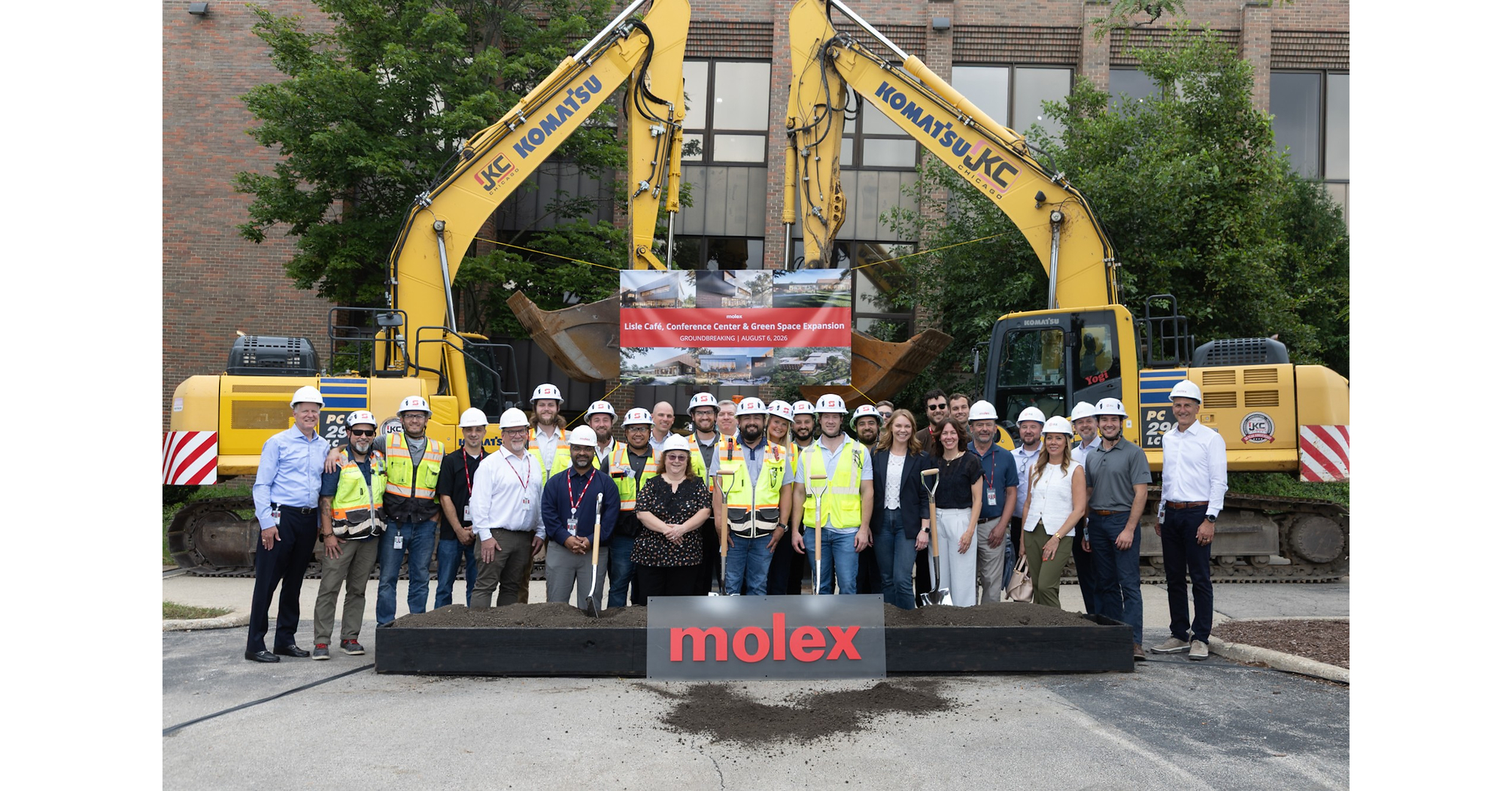
Molex broke ground on an expansion of its Lisle, IL headquarters, adding ~15,000 sq. ft. to the nearly 350,000 sq. ft. campus and integrating an adjacent property that will contribute ~80,000 sq. ft. of office and lab space. The project—expected to complete in December 2027—includes a new conference center seating 300+ with livestreaming and flexible room setups for up to 120 attendees, and is designed to support growth and add capacity for roughly 300–400 additional employees.
This is not an earnings signal; it is a read-through on where the company thinks its moat is widening. In interconnect, incremental office/lab space matters less as real estate and more as a throughput investment: more customer co-design, faster failure analysis, and tighter validation can shorten design-win cycles, which tends to favor higher-ASP, engineered-product vendors over commoditized cable/assembly players.
For public comps, the most relevant beneficiaries are TE Connectivity (TEL) and Amphenol (APH), because both monetize application engineering and have exposure to data center, industrial automation, and defense specifications where switching costs are high once qualified. The second-order effect is competitive: if Molex is spending to compress development timelines, smaller niche players with weaker lab infrastructure may lose sockets even without a pricing war. That is bullish for incumbents with broad engineering bandwidth, but only if end-demand is still absorbing new programs rather than just preserving market share.
The contrarian read is that this may be mostly optics and employee-retention capex, not a demand catalyst. If customer pipelines were truly inflecting, we would expect more explicit hiring or capacity language tied to revenue, not headquarters modernization. The risk is that management is pre-investing ahead of a slower FY27/FY28 tape, which would eventually show up as opex dilution rather than incremental growth.
Time horizon matters: near term, there is likely no tradable price reaction; over 1-3 months, watch for commentary from TEL/APH on design-win conversion and data-center backlog; over 6-18 months, the signal would matter if it coincides with sustained margin resilience in high-reliability connectors. The thesis is falsified if peer organic growth slows while SG&A expands, or if customers begin deferring program launches despite the engineering investment.
AI-powered research, real-time alerts, and portfolio analytics for institutional investors.
Request DemoOverall Sentiment
neutral
Sentiment Score
0.10
