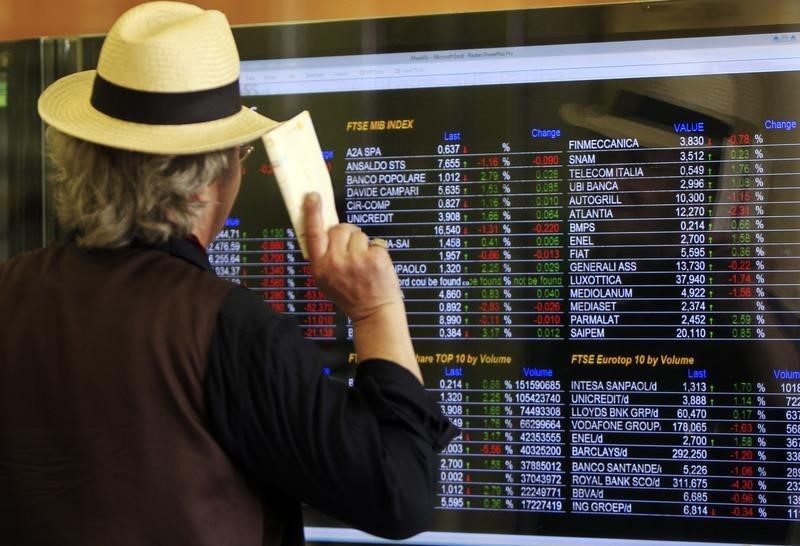
Italy's benchmark rose 1.18% to a new all-time high, led by UniCredit (+4.17%), Intesa Sanpaolo (+2.91%) and Azimut (+2.04%), while Saipem (-4.67%) and STMicroelectronics (-4.05%) lagged. Broader markets were mixed as oil sold off sharply, with WTI down 5.71% to $76.14 and Brent down 4.89% to $79.10, while gold ticked up 0.20% to $4,360.47. FX was little changed, with EUR/USD flat at 1.16 and EUR/GBP flat at 0.86.
The immediate read-through is not “stocks up on lower oil” but a cross-asset regime shift: a sharp Brent retracement removes an inflation tailwind and should mechanically compress duration risk, while simultaneously pressuring the equity beta of energy-exposed cyclicals and capital goods tied to Middle East supply-chain friction. The more important second-order effect is on autos and industrials: lower input costs can help margins, but if the oil move is driven by an improved geopolitical backdrop, the market is also implicitly pricing less disruption premium in shipping, insurance, and European manufacturing.
Within the Italian tape, the split suggests a factor rotation rather than a clean macro move. Banks and defensives are catching the bid because lower energy prices reduce recession odds and improve credit-loss expectations over the next 1-2 quarters, while industrial/technology weakness is a warning that investors are de-risking cyclicals with higher global demand elasticity. STMicro’s drop looks more like a risk-off duration/semis de-rating than a company-specific print; if yields stabilize after the oil move, that weakness should mean-revert faster than the energy-led losers.
For autos, the key issue is not whether lower oil helps consumers at the margin, but whether this comes with a stronger euro and easier financing conditions, both of which matter more for European vehicle demand over a 3-6 month horizon. Stellantis is still a low-quality beneficiary if the move is purely input-cost relief, but the market will likely fade the benefit unless order trends improve; any rally should be treated as a selling opportunity unless there is evidence of volume stabilization in Europe/US. The contrarian take is that the oil drawdown may be over-discounting geopolitical de-escalation: if peace headlines stall, the rebound in crude could be violent, making today’s risk-on rotation fragile.
AI-powered research, real-time alerts, and portfolio analytics for institutional investors.
Request DemoOverall Sentiment
neutral
Sentiment Score
0.10
Ticker Sentiment
