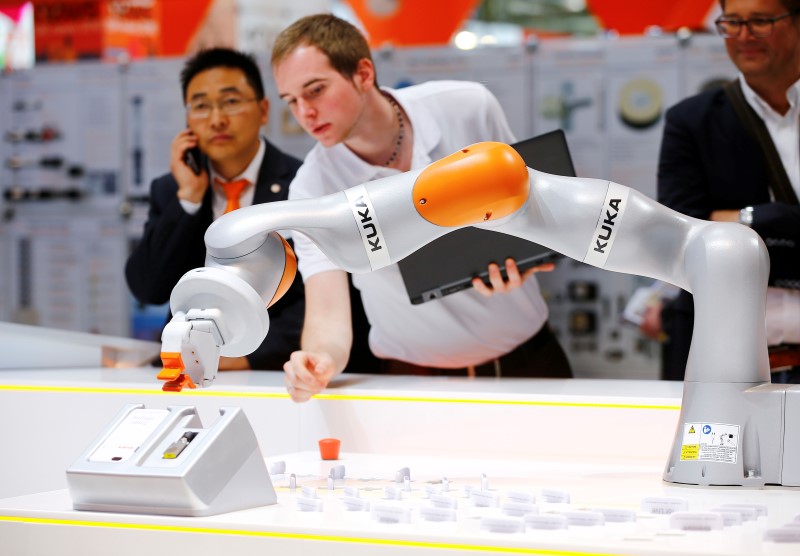
China now leads industrial robot installations by more than 295,000 annually versus 34,200 in the U.S., while also controlling 80% to 90% of key hardware components, 93% of the permanent magnet market, and nearly 99% of heavy rare earth processing. The article argues that AI competition is shifting from compute alone to industrial scale and manufacturing depth, with the U.S. leading the 'brain layer' and China the 'body layer.' The piece is primarily strategic commentary on the AI supply chain and robotics landscape, with implications for semiconductors, robotics, and rare-earth-linked suppliers.
The investable takeaway is not that U.S. AI is “ahead” and China is “behind,” but that the market is pricing the wrong bottleneck. Near term, the scarce edge is not model quality; it is the ability to convert software progress into deployed units at scale, which favors whoever controls manufacturing throughput, actuator inputs, and field deployment density. That is structurally positive for hardware integrators and supply-chain enablers, but it also means many “AI winners” will see margin pressure as pricing collapses faster than unit growth expands.
For NVDA, the bull case remains intact, but the next leg is increasingly about physical world capture rather than datacenter demand alone. If simulation-to-real training becomes the dominant adoption pathway, the real monetization pool expands into robotics stacks, edge inference, and industrial automation—yet customer concentration risk rises because a large share of future volume may be tied to a few OEMs and geopolitically constrained supply chains. SMCI is more exposed to the second-order effect that a manufacturing-led robotics boom can be capital intensive but not necessarily high-margin for the rack/compute layer, especially if customers delay purchases awaiting on-device inference efficiency gains.
The biggest underappreciated loser may be the broad basket of non-China industrial automation names that depend on scarce components sourced through China-dominated inputs. Even if U.S. robotics adoption accelerates, tighter magnet/rare-earth availability creates a built-in tax on unit economics and can delay commercialization by quarters, not years. That sets up a more nuanced trade: long the picks-and-shovels of constrained compute and simulation, short the easiest-to-price beneficiary names whose margins are most vulnerable to a price war in robotics hardware.
Contrarianly, the consensus may be underestimating how fast Chinese unit economics can compress globally and overestimating the persistence of U.S. software moats in embodied AI. If China keeps turning deployment density into training data, the market may eventually reward the lowest-cost systems integrators more than frontier compute providers. Over the next 6–12 months, the key catalyst is not a model breakthrough but evidence of robot orders converting into operating fleets; if that happens, the winners will be supply-chain owners with scarce inputs, not necessarily the names with the best AI branding.
AI-powered research, real-time alerts, and portfolio analytics for institutional investors.
Request DemoOverall Sentiment
neutral
Sentiment Score
0.05
Ticker Sentiment
