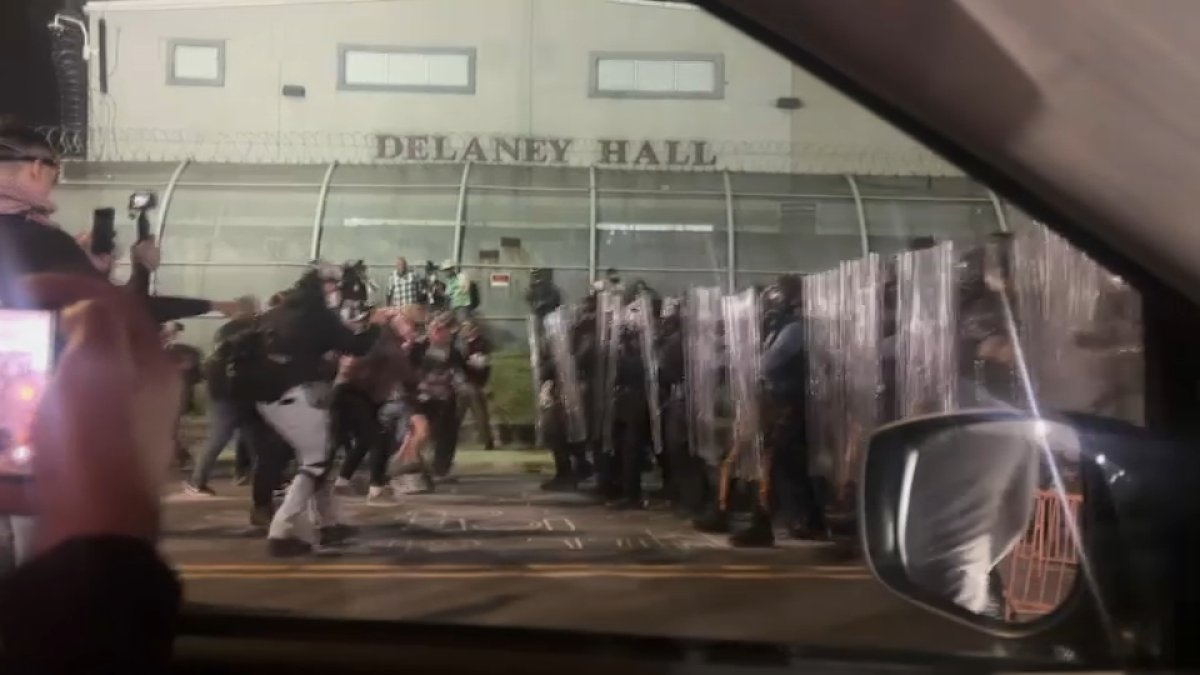
Protests outside the 1,000-bed Delaney Hall ICE detention center escalated for an eighth night, prompting New Jersey state police to establish designated protest zones after repeated arrests and clashes. The article cites tear gas, pepper spray, and reports of at least six arrests in one night, underscoring heightened local political and law-enforcement tensions. Market impact is limited and primarily reflects domestic policy and security friction rather than a direct financial event.
The immediate market read is not about the protest itself but about escalation risk around federally run detention infrastructure. Once law enforcement posture shifts from passive containment to active perimeter control, the probability distribution widens toward legal discovery, civil-rights claims, and operational interruptions that can persist for weeks rather than days. For ICE, the near-term issue is reputational and political, but the second-order effect is budgetary: more security spend, higher guard turnover, and slower throughput at the facility if staffing or access is constrained.
The bigger beneficiary is likely not obvious from the headline: private detention and security vendors with exposure to federal site hardening, transport, monitoring, and perimeter-control contracts. A more confrontational protest environment tends to force agencies into procurement decisions faster, which can support revenue recognition for contractors even when the underlying policy debate is negative. The countervailing risk is that visibly messy enforcement can accelerate oversight hearings and litigation, creating a lagged but real procurement pause if the narrative shifts from “order restoration” to “abuse of authority.”
For ICE-related equities and contractors, this is a catalyst with a short fuse but uncertain duration. The event can stay market-relevant for 1-3 sessions via headline risk, then reprice again over 1-2 months if there are arrests of officials, injunctions, or federal/state coordination disputes. If protests fade without a viral injury or lawsuit, the trade likely mean-reverts quickly; if media or legal exposure broadens, the issue becomes a broader budget and governance overhang rather than a one-off disturbance.
The contrarian read is that the market may overestimate direct earnings impact on ICE-linked names and underestimate how quickly agencies respond by formalizing zones, barriers, and access protocols. That dynamic reduces operational friction but increases the addressable market for security and detention-adjacent vendors. In other words, the negative optics can coexist with a constructive procurement backdrop, especially if policymakers frame the response as a public-safety and facility-integrity issue rather than a protest-management failure.
AI-powered research, real-time alerts, and portfolio analytics for institutional investors.
Request DemoOverall Sentiment
mildly negative
Sentiment Score
-0.20
Ticker Sentiment
