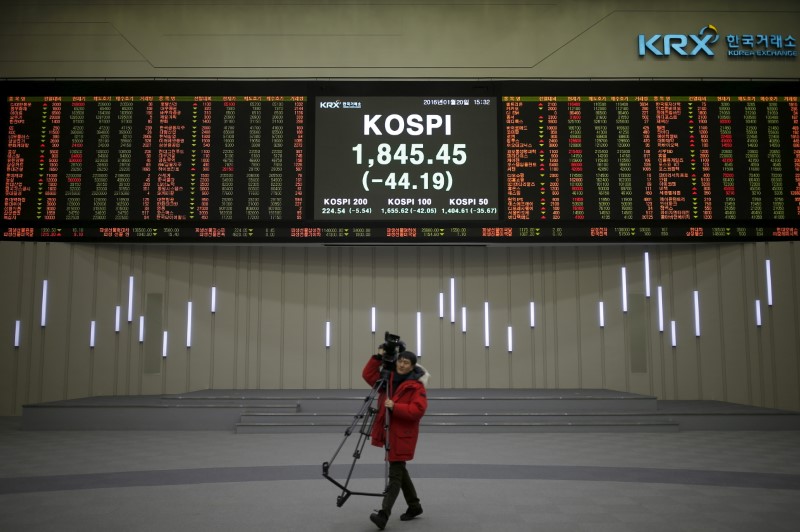
Oil prices jumped after US attacks on Iran over Hormuz shipping, adding geopolitical price pressure. Meanwhile South Korea’s KOSPI was down as much as 5.4% to a near three-week low of 7,222.60 and is ~20% below its June 19 peak, with Samsung shares sliding up to 6% despite a record Q2 profit but a revenue miss. Weakness in leveraged/inverse-ETF trading and AI valuation-sustainability concerns weighed on memory peers (SK Hynix down up to 5%) and AI-adjacent stocks like Hyundai (down 4.7%).
This looks more like a leverage-and-positioning unwind than a clean deterioration in end-demand. When a market gets crowded into a handful of AI beneficiaries, a single revenue miss versus elevated expectations can trigger forced de-grossing across the whole complex, especially with leveraged ETF activity magnifying downside. That makes the first-order loser not just the reporting company, but the entire “AI beta” basket that investors used as a high-conviction growth proxy.
The bigger second-order risk is supply-chain diversification: if large customers start qualifying non-Korean memory sources, the pain is not just lost unit share, but lower pricing power and a shorter duration of scarcity premiums. That is structurally negative for SSNLF-type exposure and any adjacent supplier whose multiple was built on a supercycle narrative; by contrast, AAPL gains optionality on cost, resilience, and bargaining leverage even if the financial statement impact is initially modest.
Over 1-3 months, the key catalyst is not headline sentiment but evidence on memory ASPs, qualification cycles, and next guidance revisions. The contrarian point is that this may be the first crack in a valuation regime that assumed flawless AI monetization; if so, the move can overshoot fundamentals. The thesis is falsified if pricing remains tight, customer diversification stalls, and Korean semis quickly regain the lost ground on stable volume outlooks.
AI-powered research, real-time alerts, and portfolio analytics for institutional investors.
Overall Sentiment
mildly negative
Sentiment Score
-0.25
Ticker Sentiment
