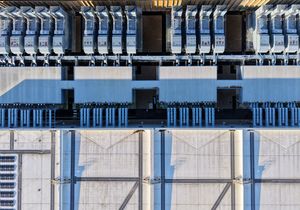
AI data center build costs are rising sharply, with one Michigan campus jumping from an initial $7 billion estimate to $16 billion and financing now including $14 billion of bonds. Construction costs, land, transformers, labor, and permitting are all inflating at once, while JLL sees average global data center construction costs rising 6% to $11.3 million per megawatt in 2026. The higher capex burden implies larger debt packages and longer financing timelines across the AI infrastructure sector.
The key second-order effect is not just higher capex, but balance-sheet duration mismatch: AI campuses are becoming multi-year assets financed with multi-year debt while the input-cost curve is still rising. That shifts risk from developers to lenders and capital providers, because any delay in power delivery or permitting extends carry costs precisely when interest expense is already elevated. The result is a self-reinforcing squeeze where projects need more upfront capital, but the probability of scope creep and refinancing stress also rises.
The clearest relative winners are the bottlenecks, not the end users. Electrical equipment, specialty contractors, and power-interconnection adjacent suppliers should retain pricing power longer than headline construction firms, while owners of entitled power-rich land should see embedded option value re-rate. By contrast, pure-play data center developers and REITs face margin compression unless they can reprice leases quickly enough to pass through higher build costs; the market is likely underestimating how much of the inflation gets trapped on the sponsor side before revenue starts.
For the brokers and advisory layer, this is a mixed setup. Near term, transaction volume and financing fees can look healthy because project sizes are ballooning, which helps the capital-markets franchises, but longer-term deal friction can suppress actual starts and reduce pipeline conversion. The broader credit implication is that larger individual financings increase idiosyncratic event risk: one permit setback or equipment delay can now move hundreds of millions of dollars of incremental debt draw timing, which is exactly where construction lenders and bridge providers can get caught.
The contrarian takeaway is that the market may be too focused on AI demand elasticity and not enough on infrastructure affordability. If capital costs keep rising faster than compute pricing falls, the bottleneck could migrate from chips to power delivery and financing capacity, slowing deployment even if demand remains intact. That argues for watching whether hyperscalers start internalizing more build risk, because if they do, third-party developers and their financing ecosystems may lose bargaining power faster than consensus expects.
AI-powered research, real-time alerts, and portfolio analytics for institutional investors.
Request DemoOverall Sentiment
mildly negative
Sentiment Score
-0.35
Ticker Sentiment
