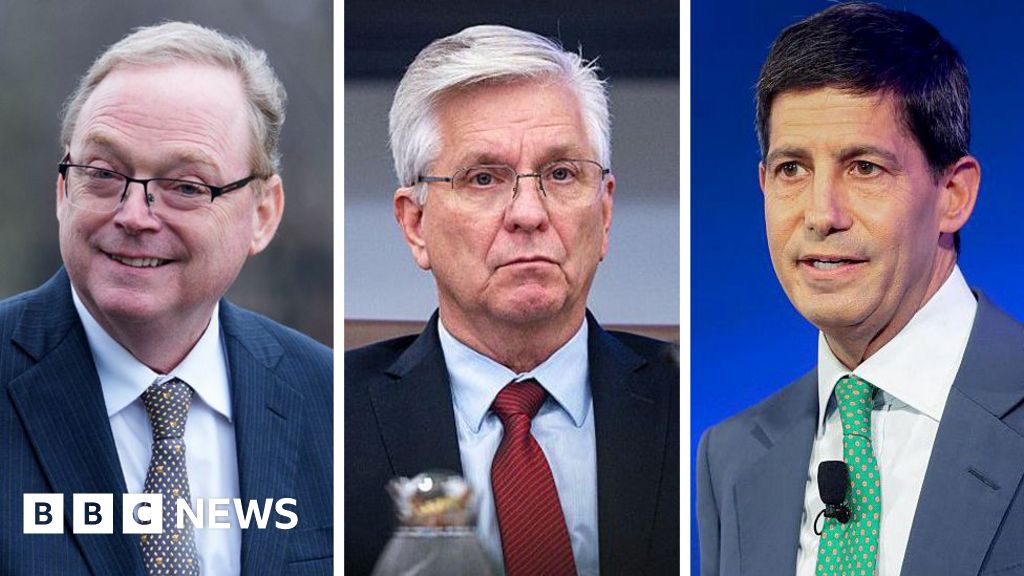
President Trump is expected to name a successor to Fed Chair Jerome Powell before his term ends in May, with frontrunners including Kevin Hassett, Kevin Warsh and Fed governor Christopher Waller. Markets and analysts are focused on how the nominee's views on interest rates, inflation and Fed independence — and potential pressure from the White House — could shift monetary policy, balance-sheet normalization and market expectations; prediction markets currently favor Hassett but Waller is gaining support. The choice could affect Fed board composition and near-term rate guidance, making the appointment a meaningful risk for fixed income and equity positioning.
Market structure: A Trump pick seen as pro-cut (Hassett/Warsh) would mechanically compress term premia and boost long-duration assets; a pragmatic insider (Waller) would restrain cuts and keep real yields higher. Winners if cuts are likely: long-duration govies (TLT, +5-10% on a 50–100bp cut priced over 3–6 months), gold (GLD), EM FX; losers: rate-sensitive growth (QQQ, high-multiple tech) and dollar carry trades if USD weakens. Asset managers (BLK) and logistics (UPS) see flow/volume effects but are secondary to macro volatility.
Risk assessment: Tail risks include politicized Fed independence triggering large risk premia — e.g., a contested nomination or signs of White House interference could widen 2s10s by 30–50bp in days and spike equity VIX >30. Time horizons: immediate (days) — elevated front-end volatility around nomination/confirmation; short-term (weeks/months) — re-pricing of Fed cuts via futures; long-term (quarters) — policy credibility erosion raising term premia. Hidden dependency: market reaction hinges on Fed-swap/funds futures mechanics and Senate confirmation timeline, not just media odds. Catalysts: Trump's formal nomination, Senate hearings, and the next CPI/PCE prints.
Trade implications: Favor tactical long duration via TLT/IEF (2–3% portfolio) if front-end priced cut odds >60% within 3 months, with stop-loss if 10y yield >4.5%. Pair trade: long XLF vs short QQQ (1:1, 1–2% net exposure) for 3–6 months to capture financials on easing while hedging tech leverage. Options: buy 3-month put spreads on NVDA or QQQ to hedge upside risk to yields; sell short-dated strangles on BLK only after volatility pick-up.
Contrarian angles: Consensus assumes a clean bond rally on any Trump nominee; that may be underdone — a credibility shock could steepen yields and crush duration trades. Historical parallel: politically pressured central banks often trigger term-premia spikes (e.g., 2018 turmoil) rather than smooth cuts. Unintended consequence: front-loaded positioning into duration could force rapid deleveraging if Senate fights prolong confirmation, so size and optionality matter.
AI-powered research, real-time alerts, and portfolio analytics for institutional investors.
Request DemoOverall Sentiment
mixed
Sentiment Score
-0.10
Ticker Sentiment
