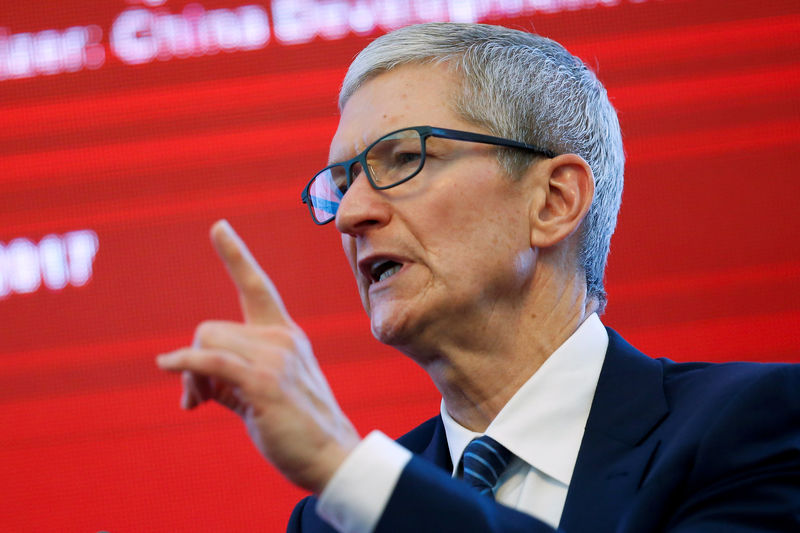
Apple announced that Tim Cook will step down as CEO and transition to executive chairman on September 1, 2026, with John Ternus named successor; the stock fell more than 1% after hours. Cook’s departure comes after overseeing Apple’s market cap growth from about $350 billion to $4 trillion and revenue growth from $108 billion in FY2011 to over $416 billion in FY2025. The change raises investor questions about Apple’s AI strategy and execution under new leadership, though the transition has been planned with board approval.
The market is likely underpricing how much of Apple’s multiple has been a single-man governance premium. A transition to a product/hardware operator should be read less as a clean handoff and more as a reset of the burden of proof: the stock now needs evidence that AI monetization can move from narrative to measurable attachment-rate gains across devices. In the near term, that creates a classic “show me” setup where upside is capped until WWDC and the first post-transition earnings print, while downside is amplified if product announcements feel incremental.
Second-order, this is constructive for Apple’s ecosystem leverage but negative for the largest platform-adjacent beneficiaries of Apple distribution if the new regime pushes harder into on-device AI, default assistant changes, or tighter control over user workflows. That would pressure revenue-share assumptions for search and app-discovery partners, while benefiting semis and component vendors tied to premium hardware refresh cycles rather than pure software monetization. In other words, the center of gravity may shift from services stability to hardware cadence, which tends to increase cyclicality in both sentiment and supply-chain orders.
The key risk is that investors mistake leadership continuity for strategic continuity. Even with a long transition window, a new CEO often changes capital allocation and product priority before the market can see it in guidance; that makes the next two catalysts the most important: WWDC for AI framing and the next two quarters for evidence of demand elasticity in flagship devices. If AI messaging disappoints, the stock can de-rate quickly because expectations have already migrated from defensive quality to AI optionality.
Contrarian view: the move may be less about uncertainty and more about de-risking a post-Cook era before execution gets harder. If Ternus is perceived as a hardware-first operator, Apple could regain credibility on product quality and launch cadence, which matters more than headline AI features over a 12-24 month horizon. That makes the current dip potentially too small for a structural short, but attractive for tactical hedges into event risk.
AI-powered research, real-time alerts, and portfolio analytics for institutional investors.
Request DemoOverall Sentiment
neutral
Sentiment Score
-0.05
Ticker Sentiment
