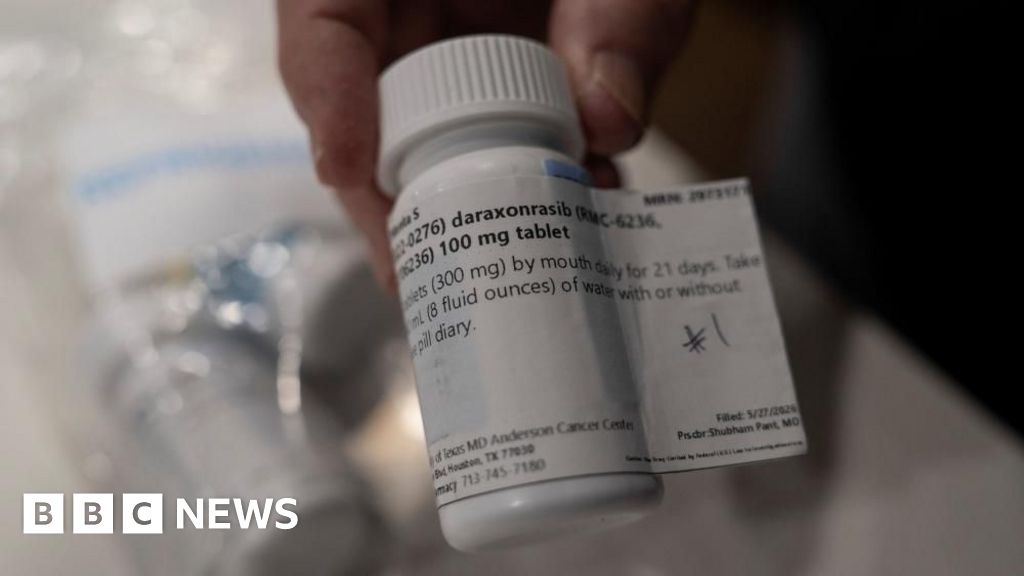
Daraxonrasib nearly doubled median overall survival in advanced pancreatic cancer, extending life to 13.2 months versus 6.6 months on chemotherapy in a 500-patient trial. The once-daily pill also reduced severe side-effects, with 43.6% of patients affected versus 57.5% on chemotherapy. The results were presented at ASCO and are being described as landscape-changing for KRAS-mutated metastatic pancreatic cancer.
This is less a single-drug story than a platform-validation event for KRAS biology. The market should think in second-order terms: a successful oral KRAS inhibitor expands the addressable treatment pool, lowers administration friction versus infusions, and materially raises the probability that combination regimens become the long-duration standard, which would shift value from generic chemo back toward oncology innovators with follow-on assets and diagnostics partners.
The near-term winner set is not just the drug sponsor; it includes companies with KRAS companion diagnostics, biopsy/liquid-biopsy workflows, and hospital systems that can reallocate chair time away from infusion-heavy regimens. The losers are incumbent chemo franchises and any competing late-stage pancreatic programs lacking a biomarker-defined edge. Over 6-18 months, the main commercial question is not efficacy alone but whether payers and guidelines accept a premium price for an oral maintenance-style therapy in a disease with high discontinuation rates.
The key risk is that metastatic oncology data often compress at the subgroup level once the trial broadens beyond mutation-enriched patients, especially if real-world tolerability or resistance mechanisms emerge after 9-12 months. A second-order downside is pricing scrutiny: if the drug’s use expands rapidly, payer pushback could cap net price and delay uptake ex-US, limiting the revenue step-up even with strong OS data. Watch for combination-data readouts, label scope, and guideline inclusion as the next catalysts; those matter more than the headline survival delta for equity re-rating.
Contrarian angle: the market may overestimate how quickly this translates into a multi-billion-dollar franchise. Pancreatic oncology is a high-unmet-need but low-prevalence market, so the stock response should be calibrated to launch curve realism and manufacturing/supply readiness, not just trial optics. The better expression may be a basket trade on tools-and-platform beneficiaries rather than an all-in directional bet on the eventual commercial winner.
AI-powered research, real-time alerts, and portfolio analytics for institutional investors.
Request TrialOverall Sentiment
strongly positive
Sentiment Score
0.86
