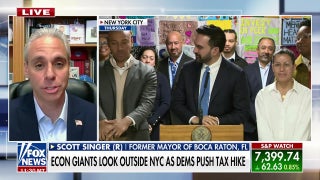
New York business leaders are responding to Mayor Zohran Mamdani’s proposed tax and anti-wealth policies, which have prompted Citadel CEO Ken Griffin to reiterate a preference for Miami and raised doubts about a planned $6 billion Midtown Manhattan office renovation. Andrew Murstein launched Operation Boomerang with $1 million of his own capital and hopes to raise $20 million-$30 million to lure businesses back to New York. The article signals elevated political and relocation risk for NYC’s commercial real estate and business climate, but the immediate market impact is limited.
The market takeaway is not the rhetoric itself; it is the growing probability of capital-allocation delay. For office landlords, contractors, and lenders tied to trophy Manhattan assets, even a modest pause in decision-making can hit leasing velocity, concession packages, and refinancing assumptions long before any formal relocation occurs. The second-order effect is that NYC’s commercial real-estate ecosystem becomes more discount-prone versus Miami/Florida peers, because the marginal tenant now has a political-risk premium embedded in their occupancy decision.
MFIN is a small-cap proxy for the “local commerce rebound” narrative, but the bigger signal is sentiment spillover into public and private financials with concentrated New York exposure. If high-net-worth households and founder-owned businesses perceive the policy regime as sticky, the feedback loop runs through tax receipts, charitable giving, event spending, and premium real-estate absorption over 6-18 months. That matters because the fiscal hole is gradual at first, then nonlinear: once peers see peers leave, the opt-out threshold drops sharply.
The contrarian read is that this is likely more about bargaining power than immediate exodus. Wealthy residents and firms are highly mobile in headlines but slower in practice because relocation costs, workforce friction, and licensing/logistics are real. So the setup is asymmetric: near-term overreaction is possible in NYC-exposed names, but the durable trade is only valid if follow-through shows up in leasing cancellations, employee departures, or budget revisions over the next 1-2 quarters.
AI-powered research, real-time alerts, and portfolio analytics for institutional investors.
Request DemoOverall Sentiment
mildly negative
Sentiment Score
-0.20
Ticker Sentiment
