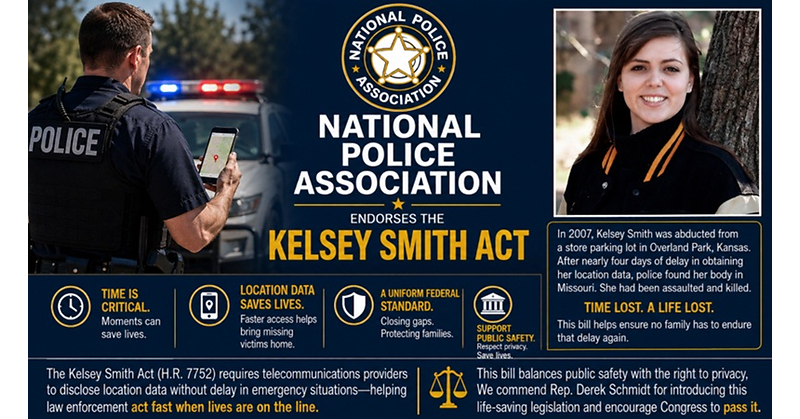
The National Police Association endorsed the Kelsey Smith Act (H.R. 7752), which would require telecom providers to disclose cellular location data without delay to officers responding to emergencies. The bill would mandate disclosure when a device requests emergency assistance in the prior 48 hours or when officers reasonably suspect risk of death or serious harm, subject to customer consent or reasonable efforts to obtain it. Market impact is likely limited, with the main effect being potential compliance requirements for wireless carriers under a federal standard.
For public equities, the direct P&L impact is close to zero; the real issue is regulatory architecture. A federal standard would mostly help the largest carriers and platform operators that already have centralized compliance workflows, while marginally disadvantaging smaller MVNOs and niche communications providers that rely on outsourced legal review and slower manual processes. The incremental cost is likely immaterial to EBITDA, but the reputational and litigation surface for telecoms rises if implementation errors become a public incident.
Near term, this is a committee-level political catalyst, not a market-moving cash-flow event. The first-order trade is not on revenue but on headline volatility: any bipartisan momentum could modestly reduce legal uncertainty around carrier data-handling, while a privacy-heavy amendment would flip the sign and create a broader selloff in names exposed to consumer trust. The most relevant second-order effect is that standardization may lower the variance of carrier response times, making them more visible as a critical infrastructure layer during emergencies.
The consensus risk is overestimating the impact on cybersecurity and data-privacy software. This bill does not meaningfully change budgets for ZS, CRWD, or PANW, and it is more likely to shift government-interface procurement than private-sector demand. The thesis would be falsified if the bill stalls in committee or is rewritten to require higher legal thresholds; either outcome would keep this in the category of political noise rather than a durable policy shift.
AI-powered research, real-time alerts, and portfolio analytics for institutional investors.
Request DemoOverall Sentiment
neutral
Sentiment Score
0.05
