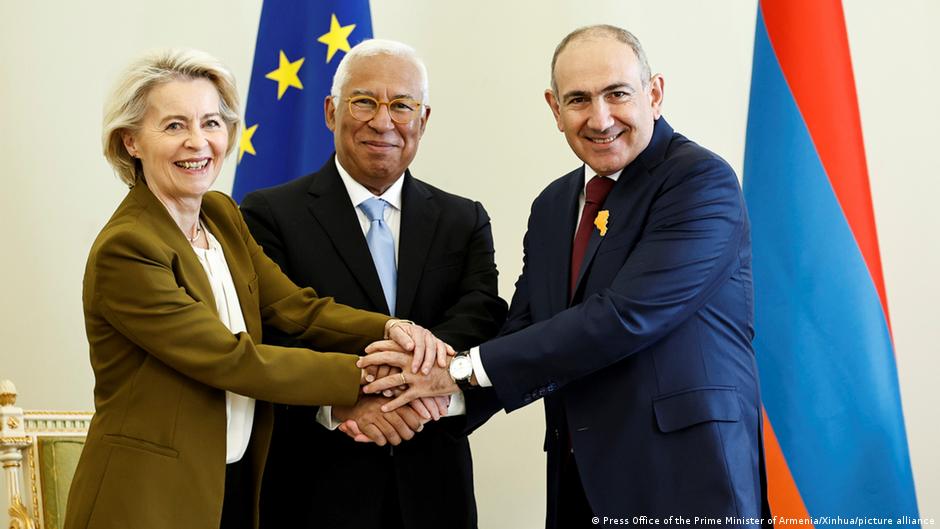
Russia recalled its ambassador to Armenia over Yerevan's push to deepen EU ties, warning that closer alignment with Brussels could undermine Armenia's membership in the Russia-led Eurasian Economic Union. Putin linked the dispute to the "Ukrainian scenario," while EEU leaders said Armenia's EU ambitions could create significant economic risks and even threaten up to 14% of GDP through potential Russian retaliation. Armenia continues to pivot away from Moscow after losses in the 2020 and 2023 wars with Azerbaijan and its 2024 freeze of CSTO membership.
This is less a bilateral spat than a broader signal that Moscow is willing to weaponize institutional leverage across the post-Soviet space to deter policy drift toward the West. The immediate market read-through is not a clean sanctions event, but a rising probability of incremental coercion: energy pricing pressure, customs friction, and selective trade barriers that can hit Armenian growth quickly while leaving headline FX and rates relatively stable at first.
The second-order effect is on corridor politics. If Yerevan keeps moving toward EU alignment while simultaneously normalizing with Azerbaijan, the key loser is Russia’s role as the indispensable security broker in the South Caucasus; that weakens its bargaining power not just in Armenia but also in Georgia and Central Asia. For markets, that matters because any disruption around transit routes, border procedures, or regional logistics can create small but persistent dislocations in EM trade flows and insurance premia over a 6-18 month window.
The main tail risk is escalation into energy and food-trade retaliation rather than military action. If Moscow follows through on gas or agricultural restrictions, the damage to Armenian domestic demand and fiscal stability could be outsized versus the nominal size of the economy, forcing tighter policy and external financing dependence. The reversal case is also clear: if EU support turns from symbolism into measurable transfers, trade preferences, or security guarantees, Armenia can absorb short-term pain and continue de-risking from Russia.
Consensus is probably underestimating how asymmetric the threat is: Russia does not need to cut off Armenia completely to change behavior; it only needs to raise the cost of ambiguity. That makes this a slow-burn political risk with occasional sharp headlines, not a one-day event, and the highest-probability path is a series of smaller retaliation steps that compress Armenia’s growth outlook while leaving headline diplomatic noise elevated.
AI-powered research, real-time alerts, and portfolio analytics for institutional investors.
Request DemoOverall Sentiment
mildly negative
Sentiment Score
-0.25
