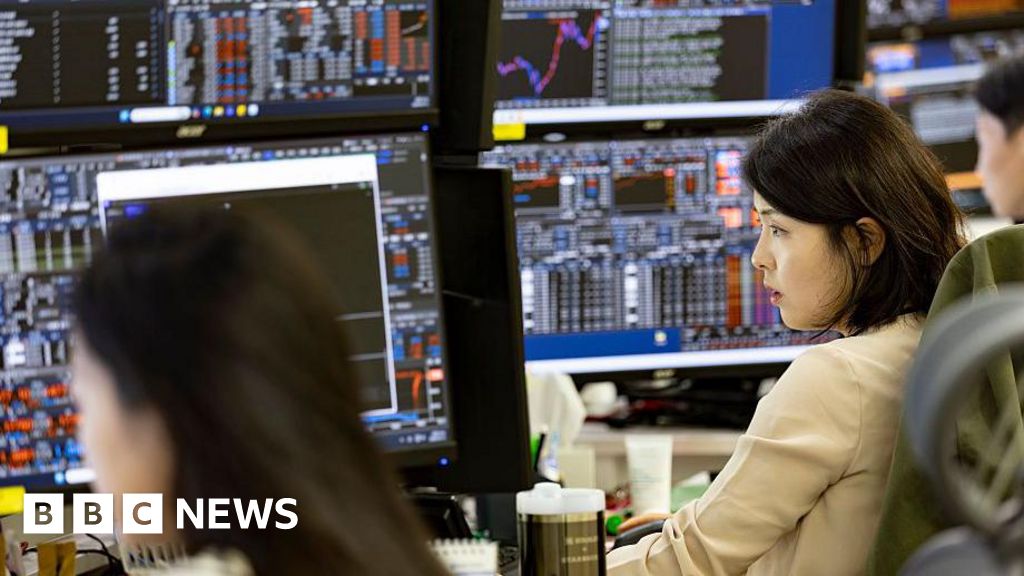
Global risk assets were under pressure as tech fears, rising oil prices, and renewed Iran-Israel strikes drove a broad sell-off. South Korea's Kospi plunged 8.3% and triggered a 20-minute trading halt after briefly falling nearly 9%, while Japan's Nikkei lost 3.9% and Taiwan's Taiex also dropped sharply; in the US, the Nasdaq still recovered 0.9% and the S&P 500 rose 0.3% after Friday's 4% Nasdaq rout. Brent crude jumped 4.6% to $97.34 a barrel before easing back to around $94, amplifying inflation and rate-hike concerns.
The market is transitioning from a single-factor AI momentum trade to a tighter regime where duration, financing, and energy inputs all matter at once. That is a worse backdrop for the most crowded parts of semis and mega-cap tech because the same names are now being pressured by higher real-rate expectations, valuation fatigue, and a hedge against geopolitics via oil. The immediate loser is the “index beta” ownership of tech: when passive flows de-risk, high-beta suppliers and hardware names tend to underperform even if the AI secular story remains intact.
A key second-order effect is that the earnings risk is shifting from demand to margin. If oil holds near current levels for several weeks, inflation expectations can reprice upward quickly, which makes multiple compression more likely than outright estimate cuts in the next 1-2 quarters. That is particularly relevant for firms with stretched capex intensity and long payback periods on AI infrastructure, where investors are already asking for proof of monetization rather than just spending cadence.
Within semis, the cleanest relative loser is Taiwan-linked hardware exposure versus more cash-generative AI platforms. TSM sits in the crosshairs because it is both a bellwether for global chip demand and a geopolitical proxy; any further weakness there can spill into the entire foundry complex. NVDA is more resilient than the average AI name because it still owns the demand bottleneck, but that also means it may trade as the most liquid de-risking vehicle if rates and oil keep moving against growth.
The contrarian view is that this may be a sharp positioning reset rather than the start of a fundamental AI air pocket. If oil retraces and no broader escalation follows, crowded shorts in semis could get squeezed hard because long-term AI capex is still under-owned relative to the narrative. The market is likely overreacting to the intersection of macro shocks, but underreacting to how quickly higher yields can reprice software/AI multiples over the next month.
AI-powered research, real-time alerts, and portfolio analytics for institutional investors.
Request DemoOverall Sentiment
moderately negative
Sentiment Score
-0.45
Ticker Sentiment
