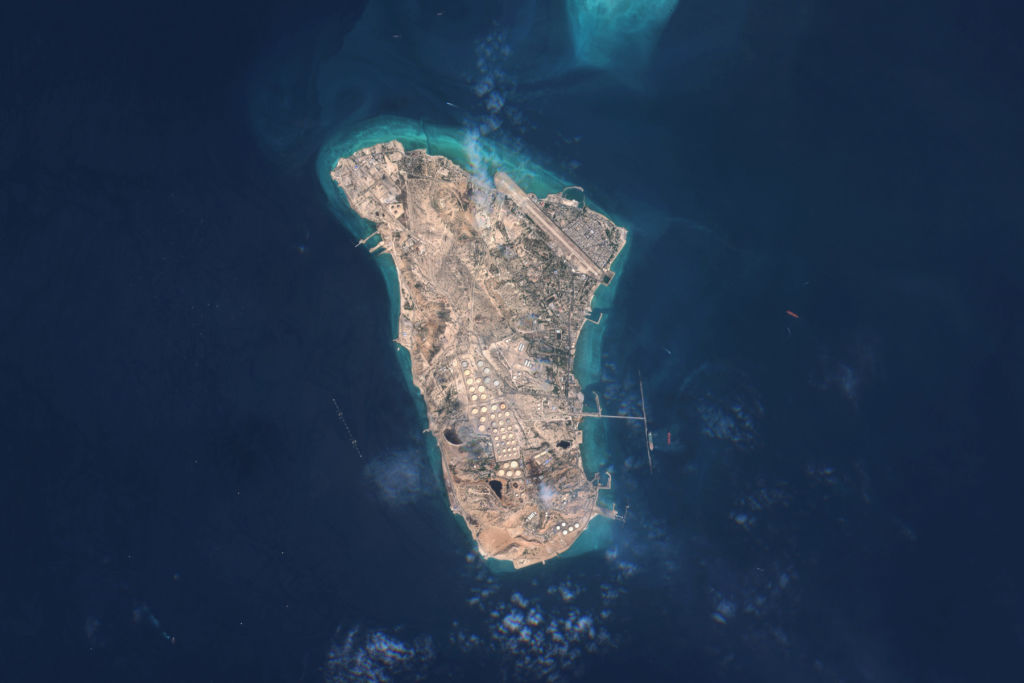
U.S. forces struck about 90 military targets on Kharg Island overnight; President Trump said he deliberately spared oil infrastructure but threatened to target it if attacks on shipping continue. Kharg previously handled ~90% of Iran’s crude exports and Iran earned ~$53 billion in net oil export revenues in 2025 (~11% of GDP), so disruption risks severe supply shocks; Brent is near $104/bbl, WTI around $98/bbl, and U.S. pump prices averaged $3.68/gal. The situation materially increases the risk of Iranian retaliation against Gulf energy infrastructure and shipping, creating a high-impact, market-wide geopolitical shock that is likely to keep oil markets volatile and drive risk-off positioning.
A concentrated disruption at a single Gulf export node creates outsized marginal effects because shipping, insurance and refining economics are non-linear: a small loss of export capacity forces longer voyages, raises VLCC/time-charter rates and insurance premia, and converts what would be a few-dollar per-barrel logistic cost into a persistent $3–8/bbl delivered premium to many Asian refiners. That spread hits refiners with thin light-heavy differentials first and simultaneously makes floating storage and arbitrage trades profitable; expect a sharp increase in spot crude contango/backwardation volatility and elevated physical storage demand over the next 30–90 days.
Control of an export chokepoint is also a geopolitical lever — buyers and state actors will quickly re-price counterparty risk, accelerating rerouting away from opaque middlemen and increasing pressure on bilateral buyers to prepay or accept haircuts. That rerating benefits liquid, transparent suppliers (and their logistics providers) while harming opaque traders and intermediaries that rely on clandestine cargo flows; commodity credit lines and trade finance spreads will widen, tightening working capital for smaller traders within 1–3 months.
Over a longer horizon (6–24 months) the conflict incentivizes hardening and diversification: GCC capex on protected berths and pipelines rises, insurers reprice marine hull/war risk leading to structurally higher shipping costs, and buyers accelerate investments in alternate supply corridors. The clearest reversers of this regime are tactical diplomacy, a coordinated SPR release large enough to eliminate near-term backwardation, or a credible ceasefire; absent one, elevated price volatility and insurance-driven cost inflation persist for quarters.
AI-powered research, real-time alerts, and portfolio analytics for institutional investors.
Request DemoOverall Sentiment
strongly negative
Sentiment Score
-0.75
