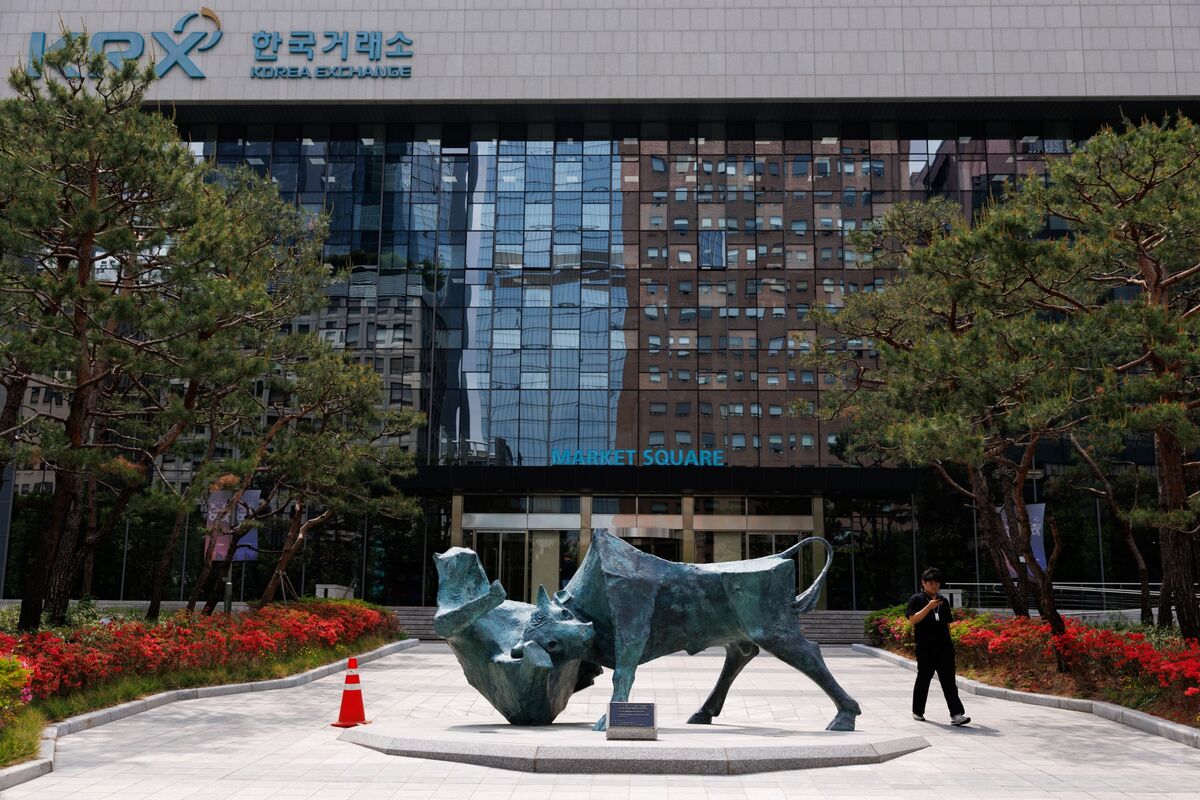
South Korea’s Kospi surged as much as 8% after President Donald Trump said the US was nearing an agreement with Iran to end the war, sharply improving risk appetite. Chip stocks led the advance, indicating broad relief buying in a market sensitive to geopolitical developments. The move has market-wide implications given the size of the rally and its linkage to global semiconductor sentiment.
This is less a clean fundamental rerating than a positioning air pocket being filled. Korea’s semi-heavy equity complex is one of the most crowded global beta expressions to risk-on headlines, so an 8% index impulse can easily overshoot the underlying macro improvement. The first-order winners are the highest beta chip assemblers and memory names, but the second-order effect is a short-covering bid across exporters and cyclicals that can persist for days even if the news flow later softens.
The more interesting trade is in relative value: Korea tends to outperform Taiwan on broad geopolitics relief because it carries more policy beta, lower foreign ownership conviction, and a larger domestic retail/leveraged component. If this move fades, the weakest hands are likely to be momentum longs financed through FX-hedged structures, which means any reversal can be abrupt rather than gradual. Watch whether the won strengthens materially; if it does, it may dampen the next leg of foreign inflows even if equities hold.
Consensus is probably underestimating how quickly a headline-driven move can transition into a technical squeeze that lasts longer than the news itself. But the market is also likely overpricing the durability of a single diplomatic datapoint: any contradiction, delay, or broader escalation would quickly unwind the move because semis are being bid as a macro proxy, not for earnings revisions. In other words, the upside is driven by reflexivity, while the downside is driven by fundamentals catching up after the squeeze.
The cleaner expression is to respect the momentum for 1-3 sessions but fade it tactically if the index gaps again without follow-through in breadth. If the peace premium remains in place, the real beneficiary should be Korea’s exporters via a softer risk premium and lower funding stress, not just semis. That argues for selective participation rather than blanket index exposure.
AI-powered research, real-time alerts, and portfolio analytics for institutional investors.
Request DemoOverall Sentiment
moderately positive
Sentiment Score
0.60
