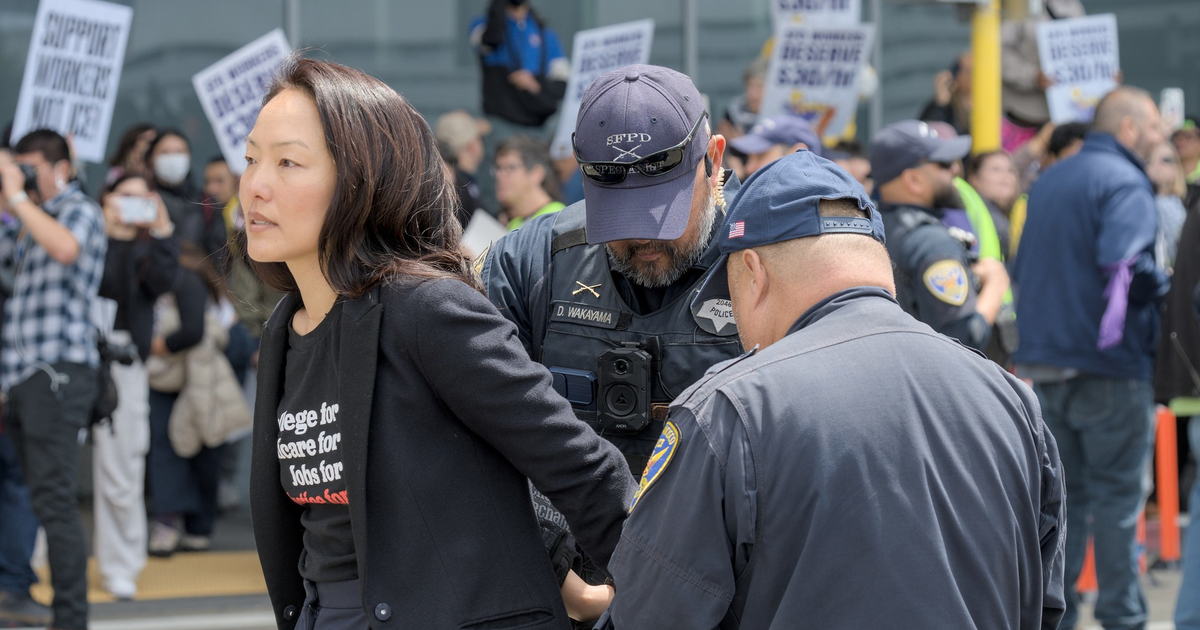
Twenty-five people, including San Francisco officials, were arrested after blocking a road outside San Francisco International Airport during a labor protest organized by SEIU United Service Workers West. The rally called for higher wages for airport workers handling cabin cleaning, wheelchair assistance, and baggage, and police declared an unlawful assembly before making arrests for failure to disperse and obstructing the roadway. The event is primarily a labor and civic protest with limited direct market impact.
This is less a direct market event than an early signal of a broader Bay Area labor-cost reset. The real second-order effect is margin pressure on any operator with exposed airport labor, but the bigger move is political: when elected officials are willing to join disruptive labor actions, the probability of faster wage settlements rises materially, and private employers lose leverage in negotiations. That tends to compress operating margins first in service-heavy transportation nodes, then across adjacent municipal contractors as wage demands cascade.
The immediate beneficiaries are labor-aligned political actors and, paradoxically, larger incumbents with pricing power. Small contractors and outsourced airport-service vendors are the most vulnerable because they lack balance-sheet flexibility and will have to eat wage inflation or pass it through into bids; that can trigger contract churn and consolidation. Over a 3-12 month horizon, expect higher labor expense to show up in airport ground handling, cleaning, wheelchair assistance, and local logistics, with spillover into municipal budgets if the same coalition pushes similar demands on city services.
The market is likely to underprice the tail risk that this becomes a template for other West Coast gateways. If protests broaden into work stoppages or coordinated slowdowns around peak travel windows, the impact is not the headline disruption but the operational premium airlines and airports may need to pay to de-risk schedules. Conversely, if wage talks are resolved quickly, the trade unwinds fast; the catalyst to watch is whether city leaders frame this as a one-off labor action or a policy mandate ahead of the next budget cycle.
Contrarian view: the consensus will likely treat this as noise because there are no listed direct beneficiaries or losers, but that misses the embedded signal for procurement costs. The setup favors companies and assets that can absorb labor inflation without service interruptions, while punishing thin-margin outsourced operators that depend on political stability more than execution.
AI-powered research, real-time alerts, and portfolio analytics for institutional investors.
Request DemoOverall Sentiment
neutral
Sentiment Score
-0.05
