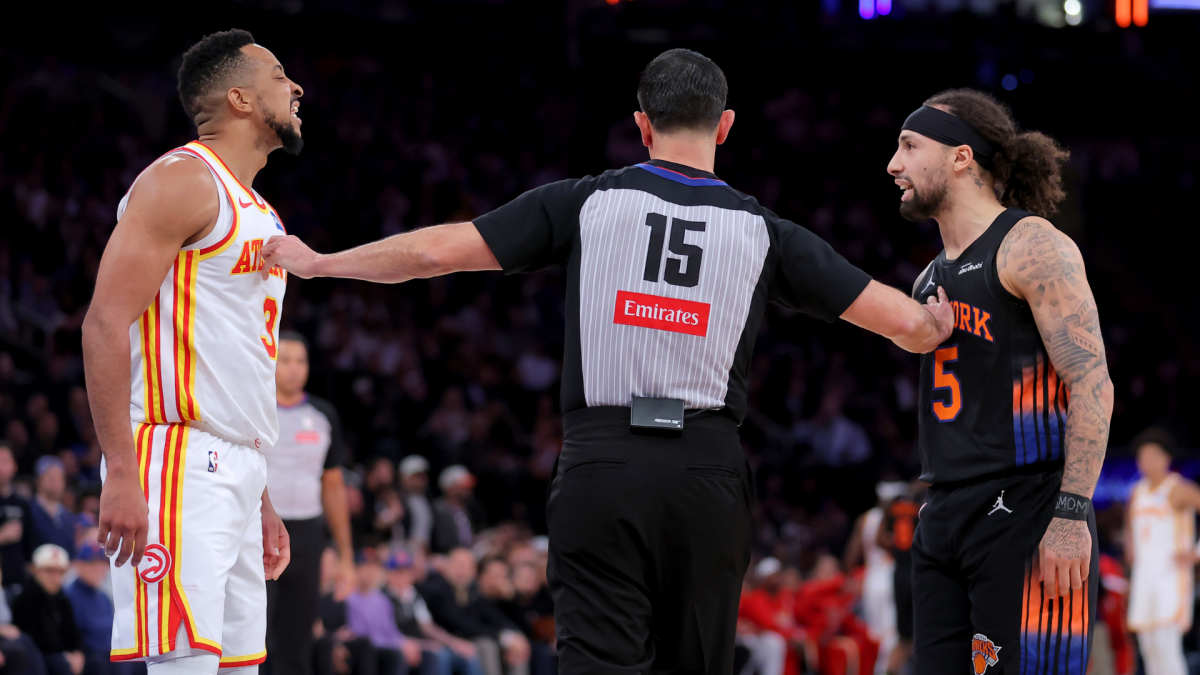
Atlanta won Game 2 107-106 to tie the series 1-1, but the article frames the result as more about playoff momentum and psychology than any financial or business impact. The Hawks were inefficient from three-point range in the second half (1-for-12) and still escaped on the road, while both teams acknowledged substantial room for adjustment heading into Game 3 in Atlanta. The tone is largely about confidence, execution, and series positioning rather than market-moving news.
This series now has a classic market-structure setup: the team with the cleaner shot quality but weaker execution just monetized variance in a hostile venue, which tends to improve home-court pricing for the next game rather than resolve the matchup. The key second-order effect is that the favorite’s margin for error is shrinking because its offense appears increasingly dependent on one creator; if that creator is forced into late-clock isolation more often, efficiency can fall off a cliff over a 2-3 game horizon even if raw scoring stays high. That creates a path where momentum and crowd leverage compound quickly in Game 3, and the market can overreact to a single home result if it is treated as a structural shift rather than a volatility spike.
From a competitive-dynamics lens, the beneficiary is the underdog’s secondary playmakers, not just the obvious lead scorer. When a defense starts overloading the primary initiator, the value migrates to the second and third decisions on each possession: short-roll passing, corner relocation, and offensive rebounding suppression. If the home side keeps getting above-the-break looks at normal volume, the more durable edge is likely on the defensive end, where rotation discipline can travel better than shot-making.
The contrarian read is that the favorite may still be the better long-run team, but the series pricing is underestimating how fragile “best player available” offense becomes against switched, physical playoff coverages. The market typically extrapolates the last game’s comeback and overweights confidence narratives, yet the more predictive signal is whether the underdog can repeat the same defensive process for 48 minutes without the variance from missed open shots reversing the result. If the underdog’s perimeter volume normalizes, the next two games could look like a tight, low-possession coin flip rather than a momentum trade.
Catalyst-wise, the next 24-72 hours matter more than the next few weeks: Game 3 should tell us whether the favorite can credibly diversify usage and whether the underdog can sustain pressure without a shooting spike. A decisive home win would likely reset public sentiment and compress upset odds; a close loss for the favorite would keep the series fragile and preserve underdog inflation. The tail risk is foul trouble or an early run forcing the favorite to abandon its preferred spacing, which would accelerate role-player volatility and make live in-game hedging attractive.
AI-powered research, real-time alerts, and portfolio analytics for institutional investors.
Request TrialOverall Sentiment
neutral
Sentiment Score
0.10
