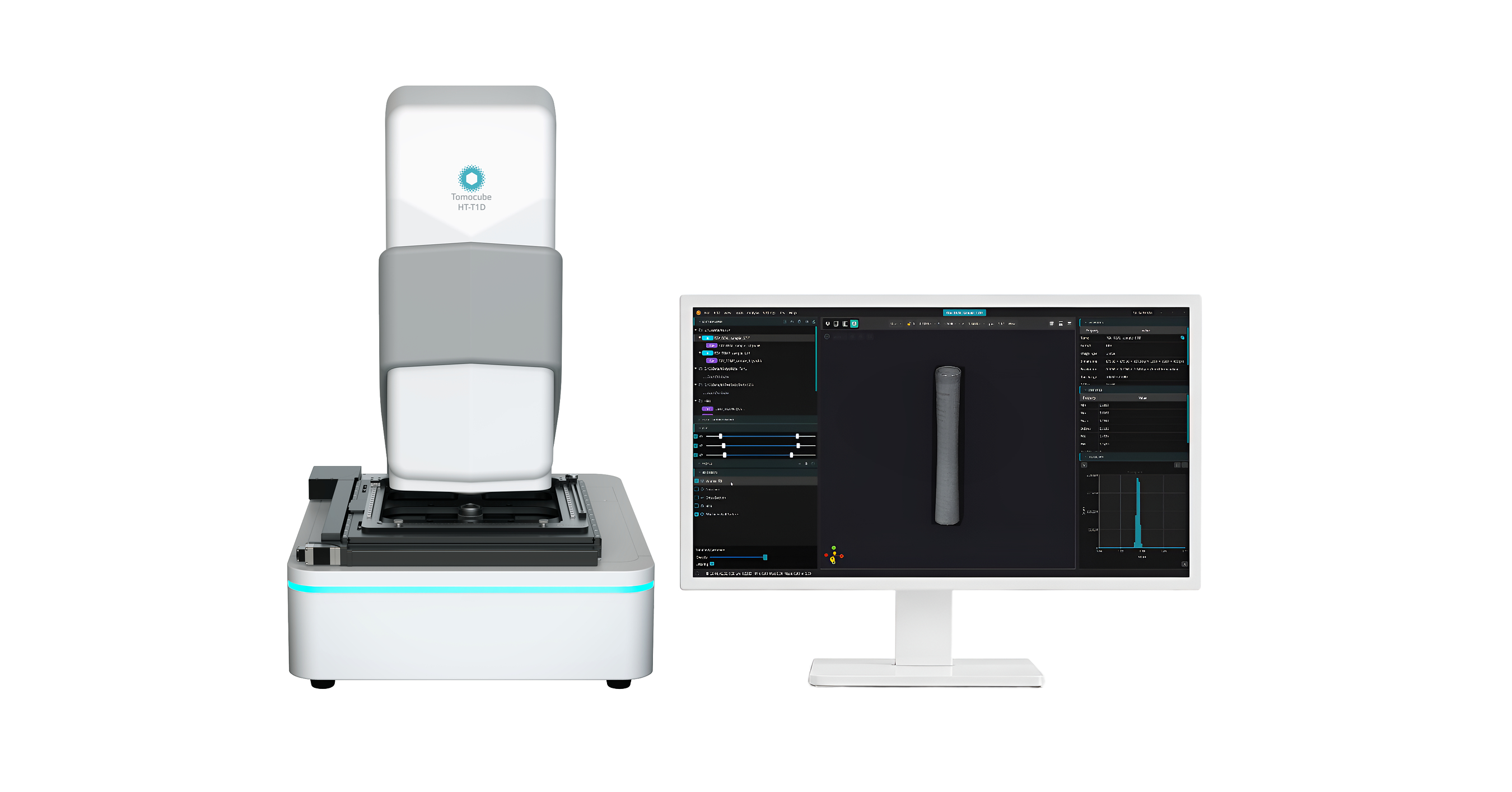
Tomocube launched the HT-T1 Desktop (HT-T1D), a desktop holotomography system for non-destructive 3D defect analysis of glass substrates used in advanced semiconductor packaging. The system reconstructs internal defect location, morphology, and depth, with refractive-index sensitivity of 10⁻⁴, and is expected to cut defect-analysis cycles from days/weeks to minutes (in applicable workflows) by reducing reliance on destructive failure analysis. Alongside the hardware, Tomocube introduced TAMI software to generate structured 3D metrology reports and connect R&D data to production-line review for faster yield learning.
The investable signal is not the vendor launch itself; it is confirmation that glass-substrate manufacturing is moving into a yield-learning phase where defect discovery becomes a line-item cost of production. In that regime, metrology and inspection vendors with the fastest debug loop gain pricing power, while commodity AOI and outsourced destructive failure-analysis lose share. Public-market beneficiaries are the inspection/metrology stack — KLA, Onto Innovation, and Camtek — with second-order support for advanced-packaging capacity holders if qualification accelerates.
Near term, the market may overestimate how quickly this converts into revenue. The first spend is likely qualification and low-volume R&D, not broad production rollout, so the earnings impact is probably 1-3 quarters away at best. The key falsifier is simple: if TSMC/ASE/Amkor and substrate makers do not start referencing glass-substrate learning or capacity ramp plans, this remains a niche lab tool rather than a meaningful capex driver.
Contrarian read: faster analysis does not fix process variation; it only shortens feedback. If defect density stays high, glass can lose share to silicon or organic interposers, pushing the thesis out 6-18 months. So this is a watch-the-adoption-curve event, not a standalone catalyst. The upside is real if glass becomes the preferred substrate for AI packaging and CPO, but that requires customer validation, not just product claims.
AI-powered research, real-time alerts, and portfolio analytics for institutional investors.
Overall Sentiment
mildly positive
Sentiment Score
0.25
