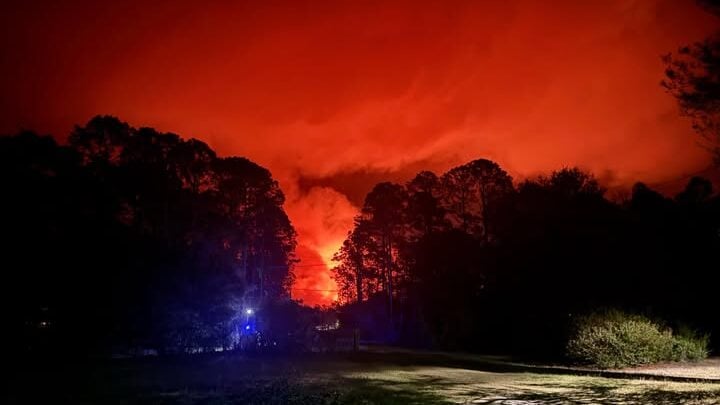
More than 27,000 acres are burning across South Georgia, including the Brantley Highway 82 fire and the Pinelands Road fire, which has spread past 16,000 acres and is only 10% contained. Evacuation orders are in place, homes and businesses have reportedly been destroyed, and smoke has degraded air quality as far north as Atlanta. Persistent drought and downed timber from Hurricane Helene are worsening fire risk, while burn bans are being imposed across the state.
The near-term market read-through is less about the fires themselves than the compounding effect on regional operating continuity: logistics, timber harvesting, paper/packaging inputs, and insurance exposure all deteriorate at once when drought, smoke, and evacuation orders collide. The second-order risk is that a contained local event becomes a broader Southeastern supply-chain nuisance if transport corridors, labor availability, or power reliability are impaired for multiple days. That argues for watching not just the burn acreage, but whether the event starts to disrupt freight schedules, mill throughput, or retail traffic across South Georgia and North Florida.
From a public-equity perspective, the more durable bearish implication is for land-intensive, biomass-dependent businesses rather than the headline emergency response. Drought plus accumulated storm debris increases the probability of higher insurance losses, higher forestry management costs, and weaker timber pricing discipline if landowners delay thinning/clearing work. If the mill-closure narrative persists, the industry loses its main sink for small-diameter wood, which should worsen fuel load conditions and create a multi-quarter feedback loop of elevated fire risk and higher remediation spending.
The catalyst profile is asymmetric: over days/weeks, the trade is mostly sentiment and local disruption; over months, it is capex and operating-cost inflation for forest products, insurers, and utilities; over years, it is a structural repricing of Southeastern timber assets if fire frequency rises. The market is likely underestimating the tail risk that a second major ignition event occurs before rainfall normalizes, which would force burn bans to extend and keep outdoor labor productivity suppressed. The contrarian angle is that the initial equity reaction may overfocus on the emergency and underfocus on the longer-dated impairment to timber supply and insurance underwriting margins.
AI-powered research, real-time alerts, and portfolio analytics for institutional investors.
Request TrialOverall Sentiment
strongly negative
Sentiment Score
-0.68
Ticker Sentiment
