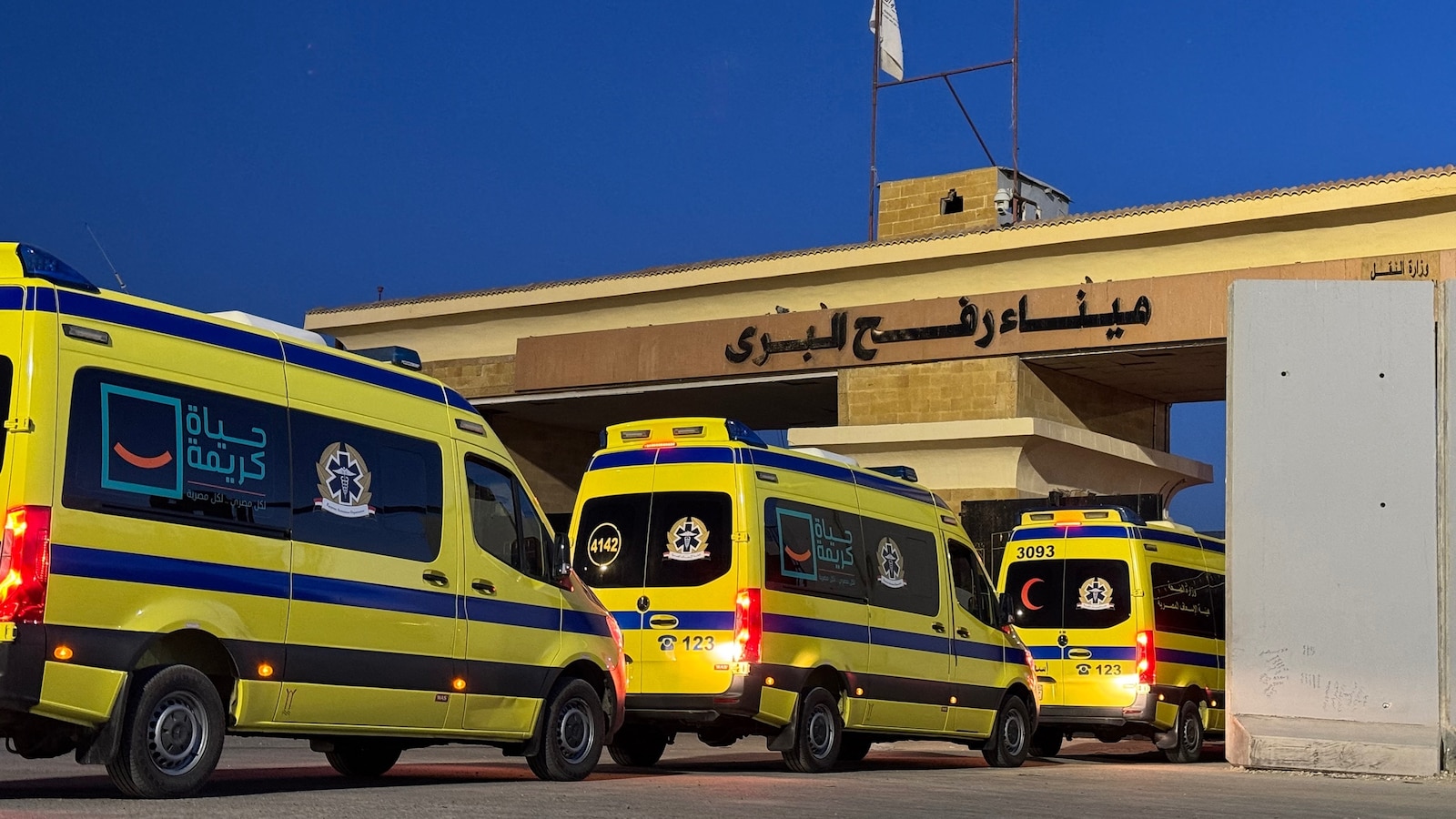
The Rafah crossing between Gaza and Egypt partially reopened to limited pedestrian traffic for the first time since it was closed to Gazans in May 2024, with EUBAM teams on site and initial movement including 15 Palestinians (five patients and 10 relatives) leaving Gaza and about 50 expected to cross into Egypt. Israel has established a new IDF-managed 'Regavim' checkpoint to vet names against security-approved lists under terms of the Trump 20-point Gaza plan, while Egypt has readied roughly 150 hospitals and 300 ambulances; Hamas says some 22,000 injured Gazans need evacuation and the PRCS notes about 10,700 Palestinians treated abroad via WHO will return after care.
Market structure: The limited Rafah reopening creates discrete winners — defense/security contractors (Lockheed Martin LMT, Raytheon RTX, General Dynamics GD) from sustained IDF/security contracting and med-tech/hospital suppliers (Stryker SYK, Medtronic MDT, Baxter BAX) from elevated evacuation/treatment volumes — and losers in regional travel/tourism (UAL, AAL) and logistics providers serving transit routes near the conflict. The 22,000 injured figure implies a material short-term uplift in demand for ICU-capable equipment and consumables; even a 10–20% ICU rate (~2,200–4,400 beds) pushes near-term consumable orders and capital equipment procurement.
Risk assessment: Tail risks include rapid regional escalation (low-probability, high-impact) that could spike Brent 10–20% in days and push funds into TLT/GLD, or conversely a diplomatic breakthrough that compresses defense rerating; trigger thresholds to watch are Brent moves >+5% in 72 hours, VIX +3 points, or >1,000 daily crossings approved which would reduce security premium. Time horizons split: immediate (days) = commodity/FX volatility and flight-to-quality; short (weeks–months) = earnings beats for defense/med-tech and order flow; long (quarters–years) = reconstruction/infrastructure wins for large contractors.
Trade implications: Tactical, size-constrained plays: 1–2% portfolio longs in LMT and RTX (split) for 6–12 month appreciation if conflict persists, funded by a 0.5–1% short in UAL or AAL to capture regional travel softness. Buy-protect: prefer 3-month bull-call spreads on LMT (buy 5–10% OTM, sell 20% OTM) to cap premium; concurrently establish 1% long in SYK or MDT to capture med-equipment demand spikes. Add 0.5–1% hedge in GLD and 0.5% in TLT if Brent >+5% or VIX jumps; consider a 1–3% tactical XLE/USO long only if Brent breaks above $90/bbl.
Contrarian angles: The market may be underpricing the short-term humanitarian-driven medical demand while overpricing perpetual defense upside; if crossings scale to >500/day in 2–4 weeks expect downward pressure on defense rerating — trim LMT/RTX at +8–12% gains. Historical parallels (limited border reopening during prior conflicts) show immediate volatility then consolidation; avoid large outright directional bets without volatility hedges and use pair trades (defense long, airlines short) to express conviction while limiting idiosyncratic risk.
AI-powered research, real-time alerts, and portfolio analytics for institutional investors.
Request DemoOverall Sentiment
mildly negative
Sentiment Score
-0.30
