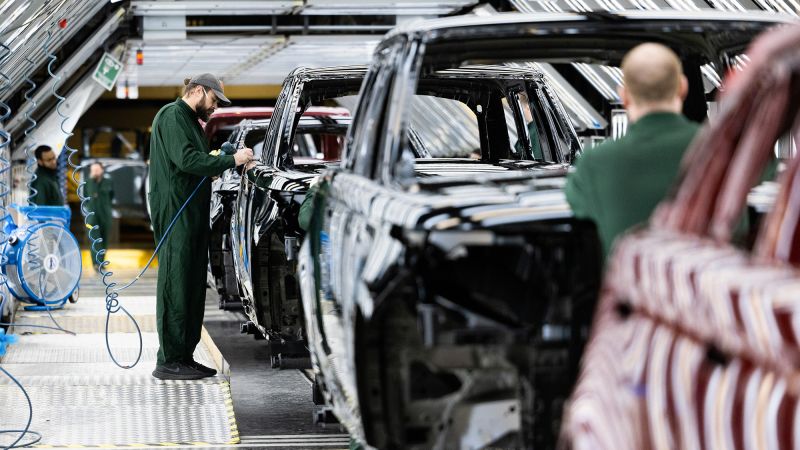
Jaguar Land Rover's operations remain largely stalled five weeks after a cyberattack, causing significant economic disruption across its extensive supply chain and the broader West Midlands regional economy. The incident has led to substantial revenue declines (15-50%) for local businesses and forced suppliers, who collectively support an estimated 100,000 jobs and an £8.7 billion regional contribution, to implement cost-cutting measures, including staff reductions. While the UK government has provided a £1.5 billion loan guarantee to JLR to aid suppliers, many within the supply chain express skepticism about the timely trickle-down of funds, highlighting severe liquidity pressure and operational uncertainty for the interconnected ecosystem.
Alex Tora knew his fish and chips shop in Solihull, England needed a boost after the pandemic, so he began offering a discount to workers from the Jaguar Land Rover factory down the road. It was a business masterstroke. Many of his customers now come from the company’s ranks, grabbing a quick lunch or picking up a “fish supper” on their way home. Or at least they were — until Jaguar Land Rover (JLR) was brought to a standstill after a devastating hack late in August. “We are about 30% down,” Tora told CNN of takings since then. “We have a strong connection to Land Rover – most of the customers are regulars, they come two to three times a week or we deliver to them during break times, so yes, we miss them.” JLR said it shut down all its systems worldwide following a cyberattack on August 31. While it said Monday that with some manufacturing to resume “in the coming days,” most of its factories remain offline. The hackers – whose identity has not been confirmed – targeted JLR, a British multinational and global powerhouse owned by the Tata Group, India’s largest conglomerate with more than a million employees and annual revenue of $180 billion. But it’s local businesses like Tora’s fish shop that are feeling the pinch. CNN spoke to more than a dozen shops and small businesses in the area around the factory and all said they had been impacted, losing between 15% and 50% of their custom in the weeks since the hack. Nemal Shanmuganathan owns a branch of One Stop, a convenience store chain. Sitting just across the road from the factory, his is the closest spot for plant workers to get snacks, drinks, newspapers or cigarettes. At the moment though, the streets are deserted and Shanmuganathan calculates he is losing about £300 ($404) in sales a day – some 15% of his usual turnover. “It is a problem. We are losing out on sales, but we still have wages to pay, bills, I have a mortgage. If it comes back tomorrow or next week, we are ok. But if it goes on for another month, I will have to make changes and cut (opening) hours,” he said. Community fears On a recent afternoon, Solihull’s town center was full of shoppers, bustling past the Tudor-period building that stands proudly at its heart. The soft, early-fall sun shone through the trees that line the pedestrian street, their leaves rich shades of yellow and orange. Union Jack bunting fluttered overhead. As other towns and cities across the United Kingdom see their high streets dwindling, Solihull’s retail and hospitality sector is booming. Branches of major restaurant and store chains have mushroomed around the center in recent years, and the local mall has become a regional go-to, so much so that Apple massively expanded its store there earlier this year. According to many, much of this success is due to JLR and the wider car industry. The West Midlands, especially its largest city of Birmingham, was England’s manufacturing heartland for decades before going into a sharp decline in the latter half of the 20th century when factories began to shut down. “The 1970s and early 1980s were particularly difficult. Hundreds of thousands of jobs lost, widespread de-industrialization… the (area) had to reinvent itself,” said David Bailey, professor of business economics at the Birmingham Business School and an expert in industrial and regional policy. JLR was a big part of this reinvention, especially in the past two decades, after it was sold by Ford to Tata Motors in 2008. The company is currently the only major car manufacturer in the UK that does everything within the country – from design and development to prototyping, building, selling and servicing the cars post-sale. “It has done very well in recent years and it’s the biggest car producer in the UK – so it’s massive and many of the jobs that it supports are very highly paid, they are well paid manufacturing jobs and there aren’t that many left of these, so it’s actually very important for the regional economy,” Bailey told CNN. JLR says it employs 10,700 people at the Solihull facility, about a third of its total UK workforce, and that it manufactures a new car there every 90 seconds. To sustain this breakneck speed of production, the company relies on a tight supply chain of mostly local companies that can produce and deliver parts on a just-in-time basis. As a whole, this ecosystem supports an estimated 100,000 jobs in the area, according to the West Midlands Combined Authority. The think tank Oxford Economics calculated that JLR contributed some £8.7 billion to the area in 2024, accounting for a whopping 4.7% of the entire regional economy. Steve Whitmarsh, the CEO of Multifleet Vehicle Management, a Solihull-based company, said that even though his business has not been directly impacted by the shutdown, he is worried about the wider effects. Whitmarsh’s company provides vehicle fleet services – selling and leasing cars, managing company fleets and facilitating rentals. While the company doesn’t supply services to JLR itself, it does serve JLR’s suppliers and other contractors in the area. If they start having cash-flow problems, Whitmarsh would see it on his balance sheet as well. “I am not sure people realize how reliant Solihull is on the employment from JLR. Almost everyone has a relative or a friend that works at Land Rover,” he told CNN. “If the worst happened to JLR, Solihull would be a hollow of its current size in terms of economy, and it doesn’t bear thinking about what would happen if that suddenly closed overnight. We saw the effects of Longbridge closing down,” he said, pointing to the massive car factory complex near Birmingham that shut down in the early 2000s, leaving thousands of people out of work. “It’s taken 20 years to recover, and it would take 20 years to recover here, I’m very sure, if not longer,” he said. Supply chain pains Raj Kandola from the Greater Birmingham Chambers of Commerce said that suppliers and companies further down the chain are most vulnerable to the knock-on effects of the shutdown. He said that a recent survey of local businesses gave a hint of the scale of the damage. Of the 84 that responded, more than three-quarters said they had seen a negative impact, with almost half describing it as significant. While Kandola cautioned that the survey was done over a very short period and with limited participants, he said the results were worrying as those 84 companies alone employ some 30,000 people. “We asked them what they have done to mitigate some of these circumstances and 35% said that they reduced staff hours… and this is just the tip of the iceberg. The longer that this goes on without any kind of financial support, the more difficulties they’ll face,” he said. The UK government announced earlier this week that it would underwrite a £1.5 billion loan guarantee for JLR, money which it said would help the company pay its suppliers. But CNN has spoken to several companies in the JLR supply chain, from large multinationals that provide parts directly to the company to smaller suppliers and subcontractors further down the line, and the majority said they did not have high hopes that the money would trickle down to them any time soon. None of the companies wanted to be identified directly, fearing that an admission of financial problems could hurt their business going forward. But all said they had already been forced to make at least some painful decisions. One large supplier that employs hundreds of people in the area told CNN it had had to lay off most of its temporary workers and reduce shifts for its full-time employees. Another company said it had to send the majority of its workers home after demand for its products collapsed. The employees are still getting paid, but at a reduced rate. A small subcontractor said it was told not to expect any new business from JLR until at least the end of the year. One business owner said that while JLR was getting a government-backed loan, he was told by his bank that he’d need to put up this home as collateral to gain access to emergency lending. West Midlands Mayor Richard Parker, who worked with the government on the JLR support package, told CNN he too was most concerned about the smaller companies in the supply chain. “My priority working with the government has been to ensure that we do as much as we can to protect the jobs of those people in the supply chain, the smaller businesses, and we are working really, really hard to get a real understanding of where the shutdown is having the most significant impact,” he said. Tora, the fish shop owner, said that while JLR gets a loan of £1.5 billion, he doesn’t expect to receive any help for his business. Tora has long worked in food and hospitality, but it wasn’t until four years ago that he was finally able to open his own restaurant. He got through the pandemic; he built up a good customer base, served award-winning food and was doing well. He said he was counting down the days until the factory reopens, and things go back to normal. “It’s a difficult time at the moment, you know? Everyone is struggling with the inflation, bills, I’m just telling myself it’s going to reopen next week, next week, next week,” he said. It’s been five weeks. And the wait goes on. The cyberattack on Jaguar Land Rover (JLR), a key subsidiary of Tata Motors (TTM), has triggered a severe and prolonged operational crisis, with most manufacturing still offline five weeks post-incident. This shutdown has immediate, quantifiable consequences not just for JLR, which typically produces a car every 90 seconds at its Solihull plant, but for the entire West Midlands regional economy. The article documents a significant ripple effect, with local businesses reporting revenue declines of 15% to 50% and JLR's suppliers being forced to reduce staff hours and lay off temporary workers. The scale of this dependency is stark: JLR's ecosystem supports an estimated 100,000 jobs and contributes £8.7 billion, or 4.7% of the regional economy. While the UK government has underwritten a £1.5 billion loan guarantee to support the supply chain, sentiment on the ground is pessimistic, with widespread skepticism among suppliers about receiving timely aid. This combination of an indefinite production halt, demonstrated damage to the supply chain, and lack of confidence in relief measures substantiates the extremely negative sentiment score (-0.75) and signals a material financial impact for TTM and a potential regional economic downturn.
AI-powered research, real-time alerts, and portfolio analytics for institutional investors.
Request DemoOverall Sentiment
extremely negative
Sentiment Score
-0.75
Ticker Sentiment
