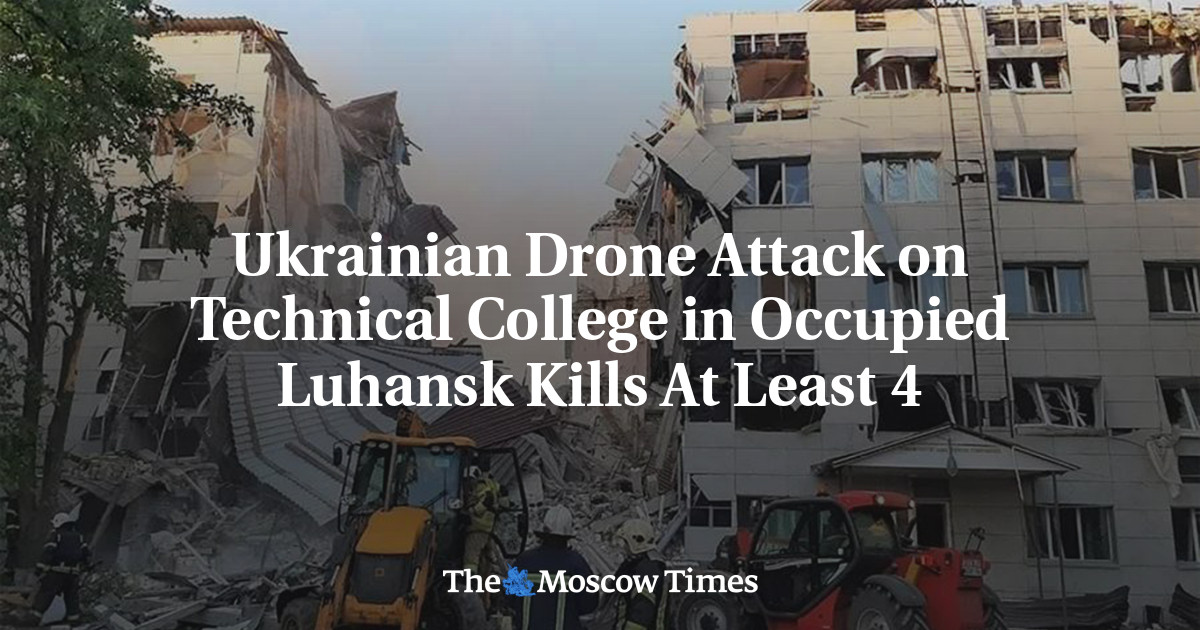
At least 6 people were killed and dozens wounded in a Ukrainian drone strike on a vocational school in the occupied Luhansk region, prompting Russia to request an emergency UN Security Council meeting. Russia said the attack targeted the Starobilsk Vocational School and opened a terrorism probe, while Vladimir Putin ordered the military to prepare retaliatory options. The incident escalates Russia-Ukraine hostilities and raises near-term geopolitical risk.
This is a classic escalation catalyst, but the market implication is less about the direct military event and more about the probability distribution shifting toward broader state-level retaliation. The key second-order effect is that Moscow now has political cover to widen strikes, harden internal mobilization rhetoric, and justify tighter control over logistics, transport, and industrial assets deeper in Ukraine — which tends to raise the premium on anything exposed to regional supply-chain disruption and reconstruction timelines.
For Europe, the more important transmission is not energy first-order, but risk-premium spillover into defense procurement, cyber, and infrastructure security budgets. The incident increases the odds of faster spending approvals and less tolerance for delay in munitions, air defense, drones, EW, and border security, which supports the defense supply chain over a multi-quarter horizon even if the immediate headline fades in days. The legal framing matters too: terrorism language and UNSC escalation increase the odds of retaliatory policy responses and sanctions rhetoric, but they also reduce the chance of near-term de-escalation, keeping volatility bid.
The contrarian point is that markets often overprice the immediate headline and underprice the lagged operational response. Unless this is followed by materially expanded Russian strikes on power, rail, or export corridors within the next 1-3 weeks, the event may function more as a narrative accelerant than a direct P&L shock. The bigger risk is complacency around drone warfare scale: repeated low-cost strikes can force expensive defensive capex and create persistent attrition in logistics, which is more durable than one-off battlefield losses.
AI-powered research, real-time alerts, and portfolio analytics for institutional investors.
Request DemoOverall Sentiment
strongly negative
Sentiment Score
-0.85
