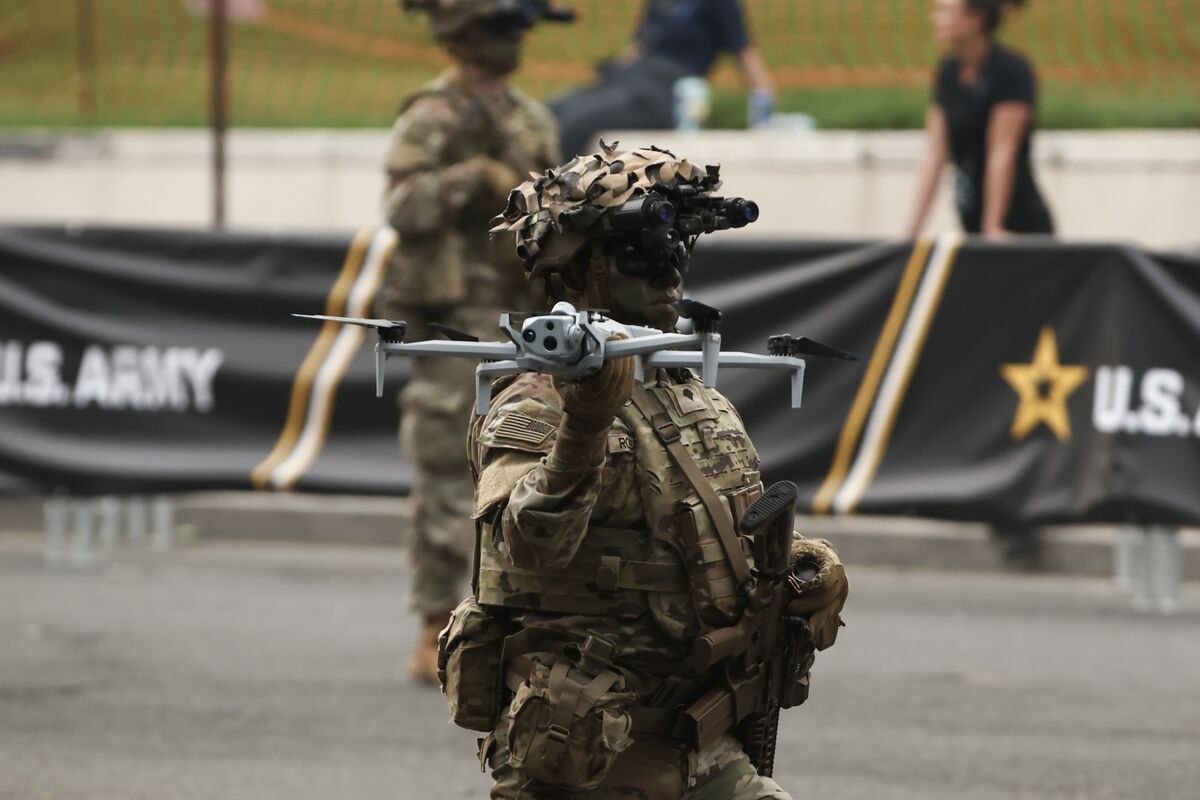
The Pentagon is seeking a record $1.5 trillion defense budget, including $75 billion for drones and counter-drone technologies. A standout allocation is $54.6 billion for the Defense Autonomous Working Group, up sharply from $225.9 million this year, implying a major budget shift toward autonomous systems and testing for US commandos. The proposal is likely to face significant congressional scrutiny but does not yet represent enacted spending.
This is less a pure budget headline than a procurement regime change: a sudden reallocation toward autonomous systems usually compresses a multi-year spending cycle into a few high-conviction test programs, which tends to favor firms with fielded hardware, manufacturing depth, and government compliance over “concept-stage” startups. The near-term winners are likely the prime contractors and subcontractors that can deliver drones, counter-drone sensors, EW, and software integration quickly; the losers are legacy platform-heavy defense names that depend on slow-moving artillery/airframe capex and may see budget share diluted.
The second-order effect is a supply-chain squeeze in components that are hard to source at scale: batteries, inertial sensors, RF chips, thermal imaging, secure datalinks, and composite airframes. If this spending is real and not just authorization theater, the bottleneck shifts from demand to production capacity, which should re-rate firms with domestic manufacturing and ignore-the-news revenue visibility. Expect margin pressure for pure-play drone assemblers if the Pentagon prioritizes domestic content and rapid iteration, while the best software-enabled integrators should gain pricing power.
The main risk is political: this kind of jump is exactly where appropriators slow-roll, re-scope, or fragment funding into smaller pots over the next 1-3 quarters. Another risk is technical disappointment — autonomy and counter-autonomy are an action/reaction market, so any highly publicized field failure, spoofing incident, or friendly-fire event could trigger a procurement pause and rotate spending back to mature systems. The contrarian read is that the market may overprice the headline and underprice the cadence: actual revenue recognition is likely to lag by 12-24 months, so the trade is not “buy drones tomorrow” but “own the enablement stack before the budget paperwork catches up.”
The best relative value is likely in diversified defense names with exposure to sensors, C2, EW, and munition-like attrition economics, not in the most crowded drone pure plays. If the budget survives congressional scrutiny, the upside is multi-year, but if it gets trimmed, the first-order disappointment will hit the most stretched autonomy names hardest while the broader defense sector remains resilient.
AI-powered research, real-time alerts, and portfolio analytics for institutional investors.
Request TrialOverall Sentiment
neutral
Sentiment Score
0.05
