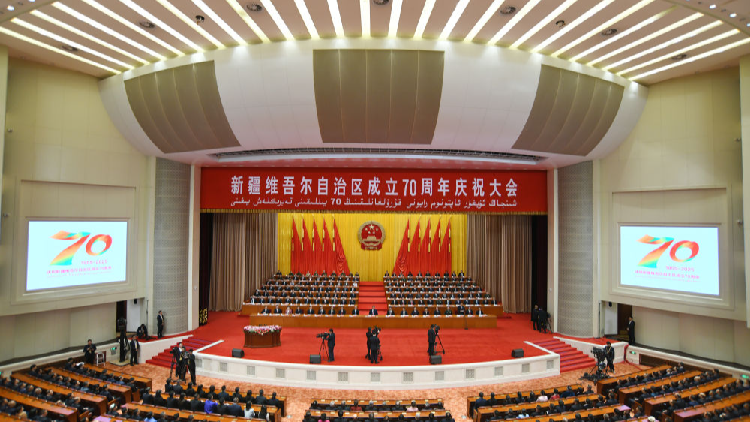
Chinese President Xi Jinping led a central delegation to Xinjiang for its 70th anniversary, emphasizing the region's strategic importance and directing efforts toward high-quality development, leveraging its resources, and accelerating its role as a core area along the Silk Road Economic Belt. The region has demonstrated significant economic growth, with its 2024 GDP exceeding 2 trillion yuan ($281.4 billion) at an 8% average annual growth rate, and has lifted 3.06 million rural residents out of poverty by 2020. Xinjiang now accounts for 92.3% of China's cotton output, boasts over 100 million kW of new energy capacity, and its pivotal geographic location facilitated 16,400 China-Europe freight trains in 2024, underscoring its expanding economic and logistical significance.
The Chinese central government's direct involvement in Xinjiang's 70th-anniversary celebrations, led by President Xi Jinping, signals a strong top-down commitment to the region's strategic development. This political backing underpins a significant economic transformation, evidenced by a regional GDP exceeding 2 trillion yuan ($281.4 billion) in 2024, reflecting an 8% average annual growth rate since 1955. The economic strategy is multifaceted, focusing on leveraging regional strengths to build a modern industrial hub. Xinjiang's dominance in key commodity sectors is notable, with its cotton output now constituting 92.3% of China's national total, making it a critical node in the global textile supply chain. Furthermore, the region is being positioned as a national strategic energy base, having achieved an installed electricity capacity of 192.7 million kW, of which over 100 million kW is derived from new energy sources. This highlights its pivotal role in China's renewable energy transition. Finally, its function as a logistical gateway is expanding rapidly; as a core area of the Silk Road Economic Belt, it facilitated the passage of 16,400 China-Europe freight trains in 2024, reinforcing its importance in Asia-Europe trade flows.
AI-powered research, real-time alerts, and portfolio analytics for institutional investors.
Overall Sentiment
strongly positive
Sentiment Score
0.85
