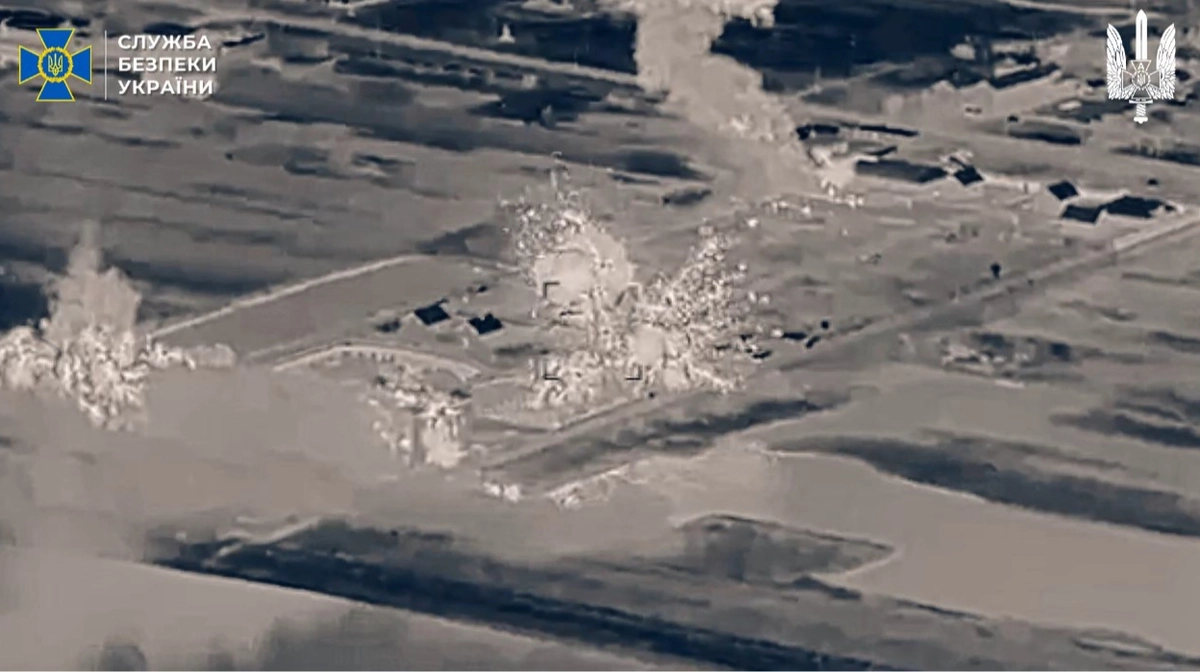
Ukrainian drones struck an FSB headquarters in occupied Henicheska Hirka, Kherson Oblast, destroying a Pantsir-S1 air defense system and reportedly inflicting around 100 Russian killed and wounded. The attack underscores continuing escalation in the Russia-Ukraine war and highlights ongoing pressure on Russian military infrastructure in occupied territory. Market impact is likely limited to defense/geopolitical risk sentiment rather than broad price action.
This is a tactically important escalation, but the market impact is likely to be more in the risk-premium channel than in direct asset repricing. The key second-order effect is psychological: strikes on command-and-control nodes and air-defense assets increase perceived fragility of rear-area security, which can force Russia to divert scarce air-defense coverage away from broader theater protection and raise the cost of sustaining occupation infrastructure. That dynamic is usually more meaningful over weeks to months than on a one-day headline basis.
The obvious beneficiaries are defense electronics and drone-supply chains, but the cleaner trade is on firms exposed to the replenishment cycle rather than the conflict headline itself. Every successful penetration of a hardened site reinforces demand for short-range air defense, counter-UAS systems, ISR, and electronic warfare, which should keep procurement urgency elevated across NATO-aligned budgets even if battlefield maps do not change materially. The less obvious loser is any near-term diplomatic de-escalation premium; these kinds of attacks reduce the probability of a fast freeze and increase the odds of a drawn-out attritional posture.
The main risk to the thesis is headline fatigue: unless strikes visibly alter logistics, casualty rates, or command continuity, the market will treat them as noise after a few sessions. The catalyst that matters is replication—if this becomes a pattern against rear-area FSB or logistics nodes, it could widen the perceived threat envelope and pull forward procurement decisions. Over a 1-3 month horizon, that would be bullish for defense suppliers, but over 1-2 weeks the move is probably too small to justify aggressive outright risk-taking.
Contrarian read: consensus may overestimate the immediate military significance and underestimate the budgetary significance. Even if the tactical damage is limited, the event strengthens the argument for accelerating European rearmament and counter-drone spending, which is a multi-quarter revenue tailwind. In other words, the best expression is not chasing the news, but positioning for sustained capex that survives a temporary ceasefire headline cycle.
AI-powered research, real-time alerts, and portfolio analytics for institutional investors.
Request DemoOverall Sentiment
mildly negative
Sentiment Score
-0.20
