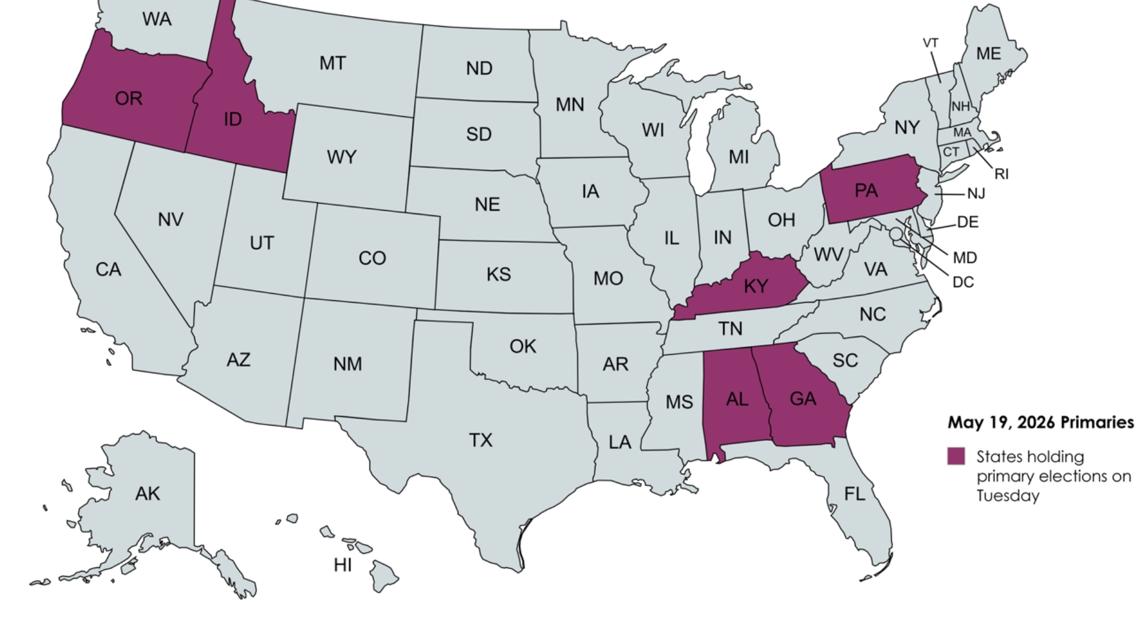
Six states held primary elections on Tuesday, with key gubernatorial and U.S. Senate contests in Alabama, Georgia, Idaho, Kentucky, Oregon and Pennsylvania. Several high-profile candidates advanced, including Tommy Tuberville and Doug Jones in Alabama, Keisha Lance Bottoms in Georgia, and Andy Barr, Charles Booker, Ed Gallerin and others in competitive primaries. The article is a broad election update with no direct market or corporate impact.
The market implication is not the election results themselves, but the de-risking of incumbency and the widening probability distribution for 2026–27 policy outcomes. The biggest second-order effect is in Republican primaries where Trump-backed candidates either validated or underperformed: that keeps the intra-party incentive structure tilted toward loyalty tests rather than district optimization, which raises the odds of future candidate quality slippage in a few swing/lean-R seats. In practical terms, that matters more for legislative productivity than for immediate macro pricing.
The clearest investable read-through is in governance-sensitive sectors. A Congress that continues to reward maximalist positioning increases headline risk for defense, utilities, healthcare, media, and any regulated business with federal exposure, but it also increases the value of scale and compliance as moat features. Smaller-cap firms with narrow political vectors are more vulnerable to single-issue campaigns, while diversified large caps should see less fundamental impact than sentiment volatility would imply.
The contrarian angle is that the market may be overpricing the medium-term durability of Trump-endorsed candidates as a uniform signal. Primary wins in deep-red or heavily partisan districts are weak predictors of general-election strength and even weaker predictors of governing discipline once in office. The more important variable is runoff fatigue and donor exhaustion over the next 6–12 weeks; that can create cheap entry points in names that sold off on ‘political risk’ but face limited actual legislative change.
AI-powered research, real-time alerts, and portfolio analytics for institutional investors.
Request DemoOverall Sentiment
neutral
Sentiment Score
0.00
