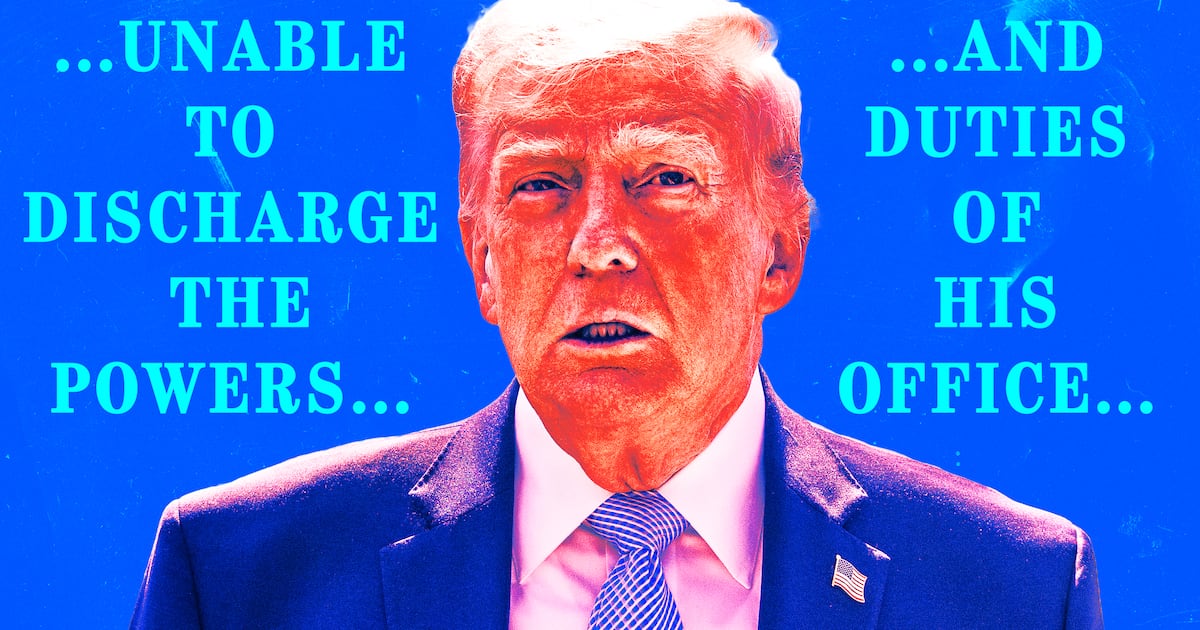
House Democrats introduced legislation to create a 25th Amendment commission that could assess President Trump’s capacity to discharge his duties, but the bill is unlikely to advance in the Republican-controlled House. The effort highlights renewed scrutiny of Trump’s health and mental acuity, including a prior request for a cognitive test and sworn testimony from his White House physician. The news is primarily political and procedural, with limited direct market impact.
This is less about an immediate constitutional outcome than about converting a political narrative into a tradable volatility catalyst. The near-term market impact is primarily on implied volatility around the November election and on any asset whose valuation embeds a clean-policy continuation assumption: defense, healthcare reimbursement, clean-energy subsidies, and regulated industries with pending approvals. Even if the bill has no legislative path, repeated discussion of presidential incapacity creates a second-order risk premium because it raises the odds of abrupt policy discontinuity, personnel churn, and executive-branch paralysis during crisis periods.
The most interesting dynamic is not regime change itself but the widening gap between headline noise and institutional execution. If the White House becomes more defensive and reactive, expect slower regulatory throughput, more legal fights, and more “on/off” decision-making around tariffs, antitrust, sanctions, and procurement. That tends to benefit firms with high cash conversion and short policy feedback loops, while penalizing levered names dependent on government cadence or political favor, especially in sectors where a few approvals or rate decisions can move earnings by multiple turns.
Contrarianly, the market may be underpricing the probability that this actually strengthens Trump’s coalition in the near term by reframing him as politically embattled, which can compress the timeline for any weakening in his support. If so, the correct trade is not to fade him outright, but to own convexity around event risk and avoid crowded directional positions that assume orderly governance. The biggest tail risk is a brief but sharp selloff in risk assets if this narrative coincides with a separate geopolitical or legal shock, because positioning is likely complacent on the combination of domestic instability plus policy uncertainty.
AI-powered research, real-time alerts, and portfolio analytics for institutional investors.
Request TrialOverall Sentiment
neutral
Sentiment Score
-0.10
