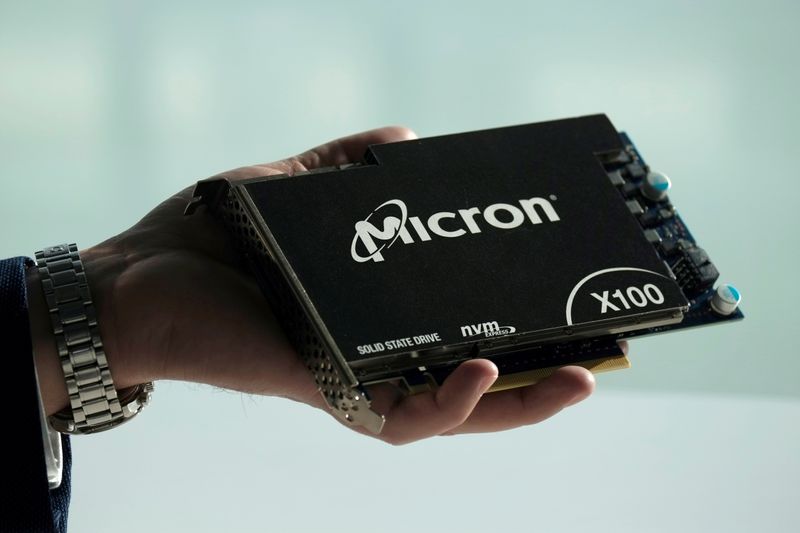
Micron shares rose 4.26% after Seagate issued strong revenue and profit forecasts, reinforcing expectations for sustained AI-driven demand for memory and storage. Commentary from Morgan Stanley and DA Davidson points to a longer memory cycle and structurally higher pricing, which is supportive for Micron’s earnings outlook. The news is positive for data-storage and memory names, but it is more company/sector-specific than market-wide.
The market is starting to price AI capex as a multi-year demand floor rather than a one-off cycle, and that matters because memory is the highest-beta way to express that view. If enterprise and hyperscaler spending stays elevated, the second-order effect is tighter bit supply, better contract visibility, and a shift from spot-driven pricing to more durable ASP support over the next 2-3 quarters. That is disproportionately positive for vendors with node leadership and tight product mix, while lower-tier memory players risk being squeezed on both pricing and utilization.
The more interesting read-through is that storage and memory are no longer just beneficiaries of AI compute; they are becoming a required input to the model-training ecosystem. That creates a feedback loop where every incremental GPU rack also pulls through NAND, DRAM, and adjacent infrastructure spend, which can keep the cycle extended even if headline AI order growth slows. The risk is that this becomes self-reinforcing only until inventory normalization or a capex pause hits, at which point these names can de-rate very quickly because the market still trades them as cyclical semis.
For Seagate, the near-term setup is cleaner because guidance credibility tends to matter more than long-duration TAM narratives; strong outlooks often lead to multiple expansion over the next few weeks. For Micron, the upside is larger but also more fragile: the stock needs continued evidence of pricing discipline and DRAM/NAND supply restraint to sustain a rerate. Morgan Stanley’s constructive stance on the storage complex likely supports a momentum trade, but the consensus miss is that the best risk/reward may sit in the ecosystem suppliers with less balance-sheet and memory-cycle exposure than MU itself.
The main contrarian risk is that investors are extrapolating AI storage demand too far into 2025 before proving out conversion of pilot deployments into sustained enterprise purchasing. If hyperscaler capex guides down even modestly, memory names can unwind sharply because positioning is crowded and expectations are now shifting upward. A sharper-than-expected downturn in broader semicap demand would also expose how much of the current strength is narrative-driven versus order-book-driven.
AI-powered research, real-time alerts, and portfolio analytics for institutional investors.
Request DemoOverall Sentiment
moderately positive
Sentiment Score
0.62
Ticker Sentiment
