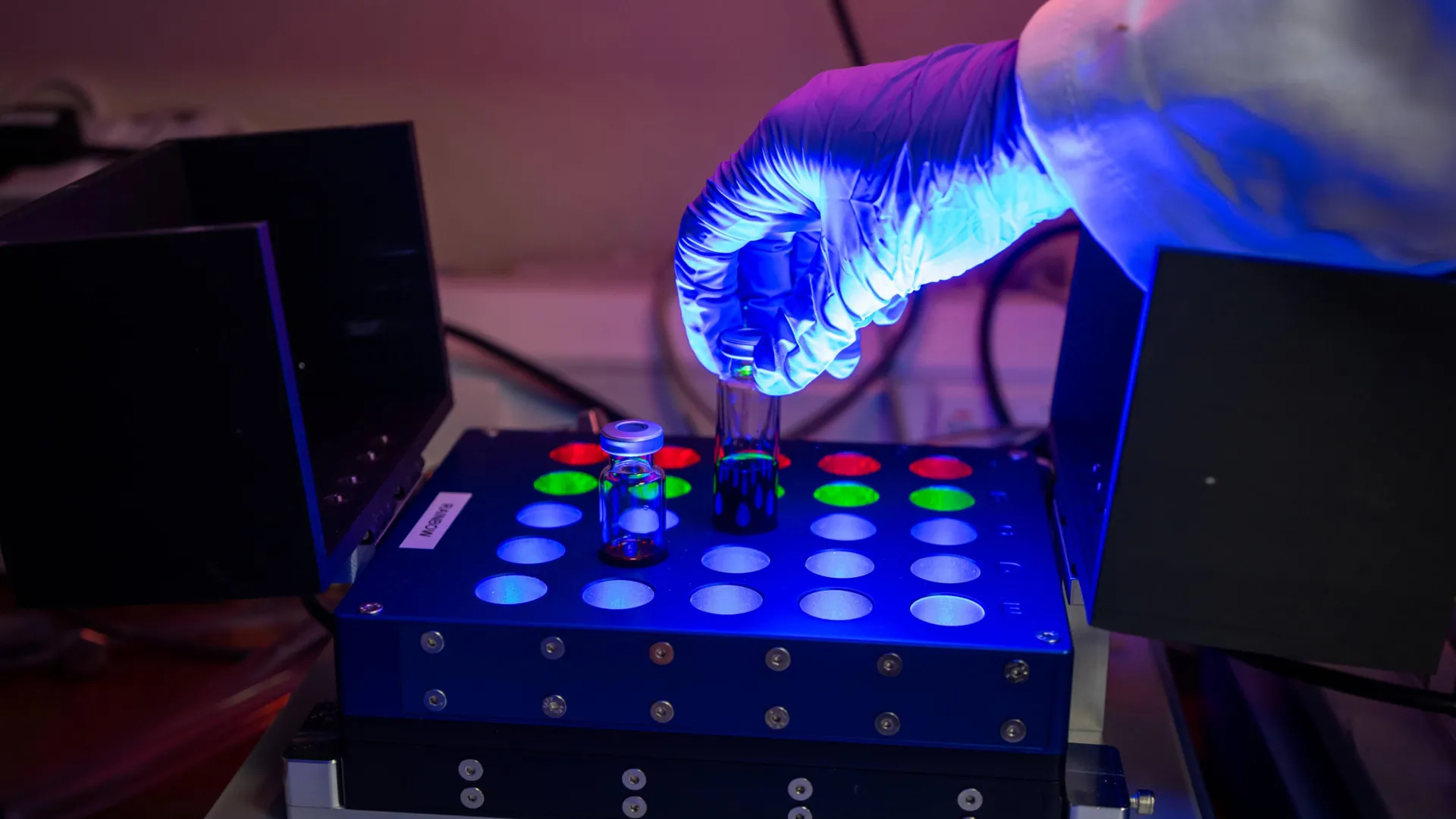
University of Cambridge researchers published an LED‑driven 'anti‑Friedel‑Crafts' photoinitiated alkylation (Nature Synthesis, Mar 12, 2026) that forms carbon–carbon bonds at ambient conditions, enabling late‑stage modification of complex drug candidates without heavy metals or harsh reagents. The method was validated on diverse drug‑like molecules, adapted to continuous flow, and tested with AstraZeneca, while machine‑learning models predict site selectivity—together suggesting faster lead optimization, fewer synthesis steps, and reduced toxic waste. Commercial and large‑scale impact remains contingent on industrial validation and regulatory/scaleup hurdles.
This development reshapes the incumbency map in small‑molecule optimization: firms that can integrate photon‑driven, flow‑compatible chemistries into their medicinal chemistry and CDMO stacks will capture outsized margin and time‑to‑clinic advantages, while suppliers tied to legacy homogeneous metal catalysis (palladium/platinoids, specialty ligands) face demand erosion over a multi‑year window. Expect a 12–36 month bifurcation where early adopters (large pharmas with internal chemistry scale or agile CDMOs) win faster candidate iteration and pricing power; laggards incur rising synthetic overheads and longer lead times.
Key operational constraints are not scientific novelty but scale and IP: industrial adoption hinges on photon‑delivery engineering, photoreactor/flow retrofits, and clear freedom‑to‑operate. These factors create discrete catalysts for re‑rating—public pilot programs, licensing deals, or CDMO service launches will move equities; failed scale trials or broad patent blocks will blunt upside. Timeline: pilots and bilateral CDMO tests move markets within 6–18 months; broad replacement of legacy workflows is a 2–5 year story.
Second‑order macro impacts matter for ESG‑sensitive capital: reduced hazardous waste volumes and energy use lower remediation and compliance cost tails, which can compress operating costs for adopters and unlock ESG multiple expansion. Conversely, commodity cycles for Pd and specialty solvents could soften, pressuring niche suppliers and commodity‑exposed chemical names before the pharma winners fully re‑rate.
The consensus underestimates two things: (1) licensing/royalty optionality from academic origins can create recurring revenue streams for early partners and lift margins without proportional R&D spend, and (2) the combination of predictive AI plus this synthetic shortcut is multiplicative—what looks like incremental efficiency today can become a volume accelerator for small‑molecule pipelines, driving multiple expansion for integrators rather than for raw chemical vendors.
AI-powered research, real-time alerts, and portfolio analytics for institutional investors.
Request DemoOverall Sentiment
moderately positive
Sentiment Score
0.45
Ticker Sentiment
