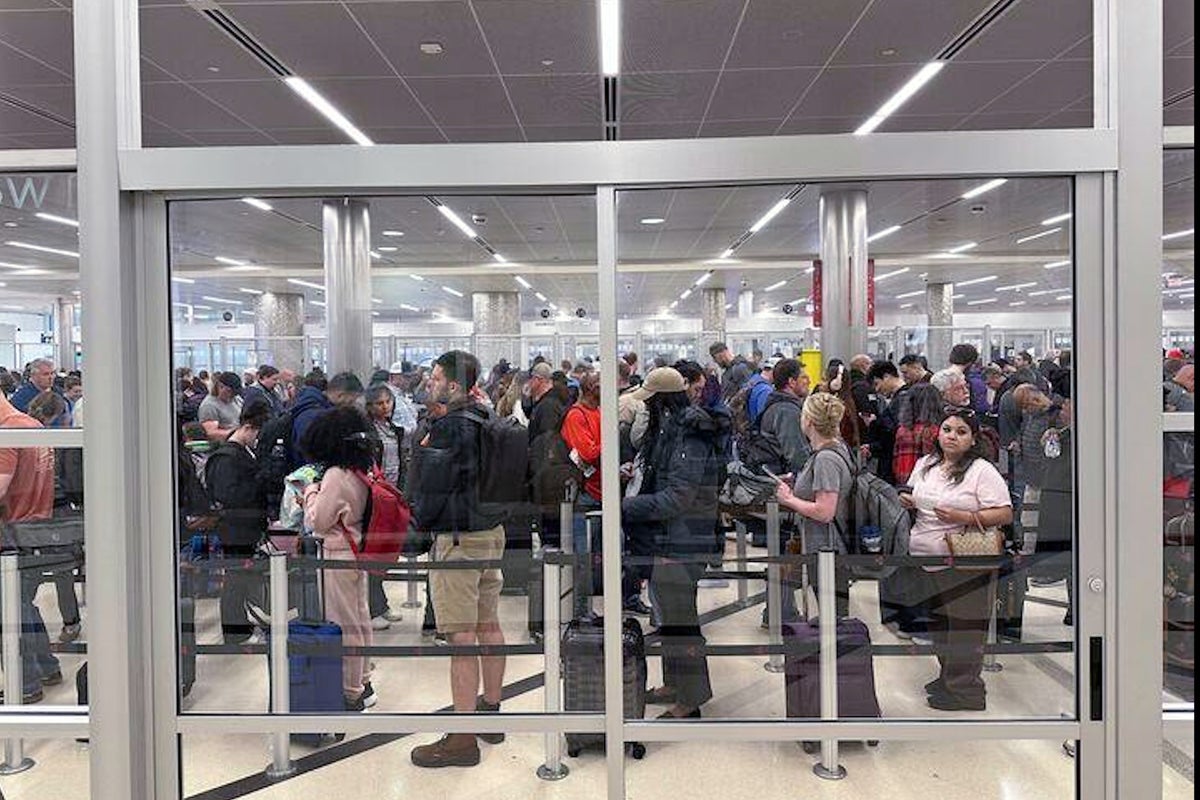
More than 12,500 U.S. flights were canceled or delayed Monday—FlightAware reported roughly 4,000 cancellations and over 8,500 delays as of 4 p.m. ET—after severe storms across the eastern U.S. and FAA-imposed ground stops at major hubs. The partial Department of Homeland Security shutdown since Feb. 14 has strained TSA staffing (Homeland Security reports 300+ TSA quits), exacerbating security lines and operational disruption amid spring-break and March Madness travel. Airline CEOs have urged Congress to restore DHS funding to ensure pay for federal aviation workers and limit future operational fallout.
Operational disruption from intermittent weather is now intersecting with a fragile labor buffer in aviation screening; that pairing creates non-linear cost and reliability shocks that outlast the weather window by weeks. Even short, high-impact days of irregular operations force airlines into re-accommodation, incremental hotel/rental-car spend, and crew repositioning costs that bleed margins and degrade on-time metrics — metrics that feed loyalty-program economics and corporate RFP renewals on a quarterly cadence.
Second-order winners are concentrated in the transient-stay and ground-transport ecosystem (hotel and rental-car operators) and in short-duration lodging/ancillary vendors who capture out-of-plan spend; these pockets can see outsized revenue per stranded passenger for 48–72 hours while airlines absorb refund and crew costs. Conversely, large legacy carriers face both immediate ticket-issuance and longer-term reputational losses that could depress willingness-to-pay among frequent business travelers, with measurable booking elasticity appearing over 1–3 quarters.
Near-term catalysts that will resolve or amplify this regime are binary and dateable: (1) an agreement to restore DHS payrolls (days–weeks) which would materially reduce staffing attrition risk, and (2) a cluster of spring travel demand events (weeks) that will expose operational resilience. If payrolls remain unresolved, expect persistent hedging activity, elevated option vols on airline names, and a tapering in service quality that compounds into lower ancillary yields over the next 2–6 months.
AI-powered research, real-time alerts, and portfolio analytics for institutional investors.
Request DemoOverall Sentiment
mildly negative
Sentiment Score
-0.30
