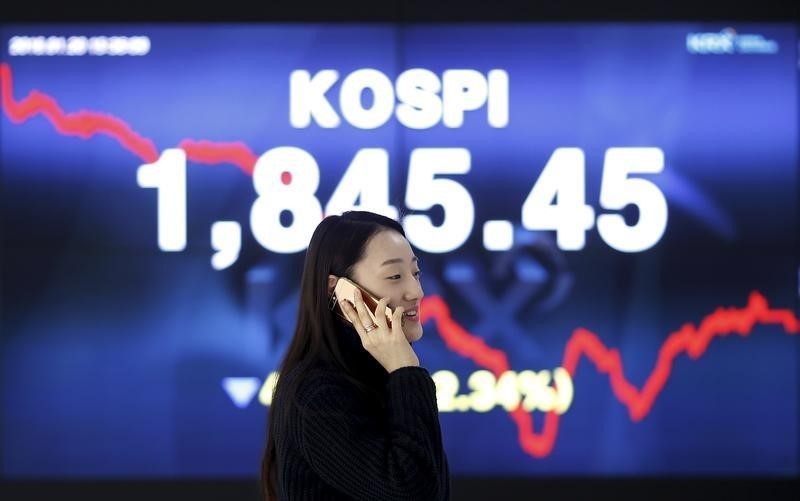
South Korea’s KOSPI fell more than 8% on Friday, triggering a circuit breaker and halting trading for 20 minutes, its fifth halt this year and third this week. Samsung Electronics and SK Hynix each dropped over 9% as investors sold fragile chip stocks amid Apple’s price hikes, reports of a possible OpenAI IPO delay to 2027, and broader AI-trade de-risking. Despite the weekly slump, the index is still up about 90% year to date in 2026, but volatility has clearly spiked.
This is less about one bad tape and more about a crowded-factor unwind in a market that had become a single-theme expression of AI memory demand. When two names dominate both index performance and household leverage, the marginal seller is no longer fundamental; it is mechanical de-risking, which can keep pressure on prices well beyond any single headline. That creates a reflexive loop: lower chip prices compress local collateral values, which can force further selling into the same names that anchor the benchmark.
The second-order beneficiary is not necessarily U.S. semis broadly, but the less-consensus parts of the AI stack: software, networking, power, and data-center infrastructure that are not directly exposed to memory ASP compression. If the market starts treating memory as a mean-reverting commodity rather than an AI scarcity asset, the multiple gap between memory leaders and “picks-and-shovels” should widen. The Apple price move matters mainly as a signal that end-demand is absorbing cost inflation poorly, which is bearish for the entire device replacement cycle and bullish for component substitution and mix-down risk.
The overhang should persist over days to weeks because circuit-breaker behavior and leveraged products mechanically extend volatility, but the real catalyst window is 1-3 months: earnings guidance, capex commentary, and any sign that AI capex is being re-phased rather than paused. If OpenAI delay chatter becomes a broader narrative around monetization slippage, the market may re-rate AI infrastructure on payback timing rather than TAM alone. The contrarian read is that this may be a violent but healthy reset: if memory pricing holds and capex remains intact, this is a positioning correction more than a thesis break; if prices keep breaking lower, the unwind can overshoot and create a better medium-term entry point in quality AI beneficiaries outside memory.
AI-powered research, real-time alerts, and portfolio analytics for institutional investors.
Request DemoOverall Sentiment
strongly negative
Sentiment Score
-0.78
Ticker Sentiment
