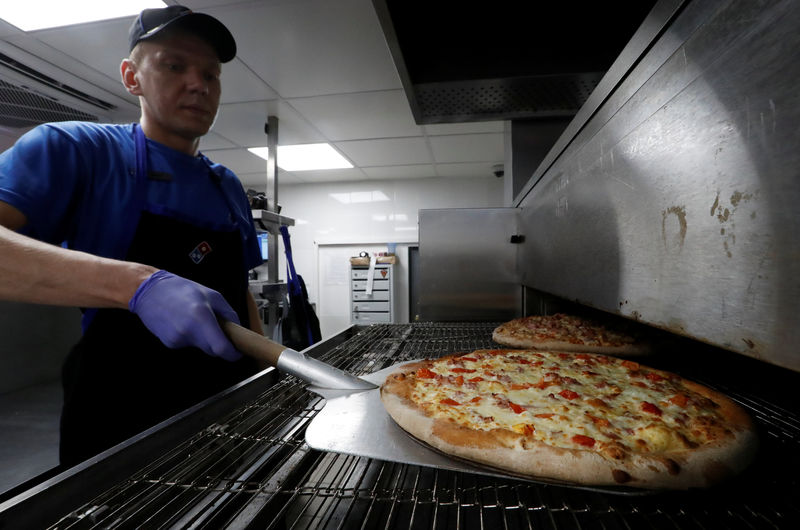
Bank of America says Domino’s and Casey’s are emerging as the biggest winners in U.S. pizza market share, with category sales expected to reach $43.4B in 2025, up 3.1% year over year. Domino’s has been gaining delivery and carryout share since 2021, while Casey’s is expanding foodservice sales through value offers, loyalty, and convenience-store penetration. The report suggests both names are well positioned as third-party delivery disruption normalizes and competitive pressures ease.
The key read-through is not just share gain for the two named operators, but a slow re-pricing of the entire pizza profit pool toward brands with either scale economics or embedded traffic engines. If third-party delivery moderation persists, smaller standalone pizza chains lose an external demand tailwind they were structurally dependent on, while operators with carryout density, loyalty data, or adjacent traffic generators can capture disproportionate mix shift. That makes the competitive damage most acute for weaker traffic names and delivery-only exposure, even if they are not explicitly mentioned.
The bigger second-order effect is margin resilience. In a normalizing delivery environment, discount intensity should ease and marketing efficiency should improve, which matters more to unit economics than top-line growth over the next 2-4 quarters. Casey’s has a built-in hedge because fuel traffic subsidizes foodservice acquisition costs; Domino’s has the cleaner operating leverage if carryout continues to outgrow delivery, since it avoids the most expensive part of the last-mile equation.
The market may still be underestimating how durable this relative-share shift can be if consumer behavior stays value-oriented. Pizza is a high-frequency category, so even small changes in basket economics can compound into meaningful share gains over 12-24 months. The main reversal risk is a renewed delivery-platform promotion war or a sharp consumer downtrade that forces all players back into aggressive discounting, which would compress margins and blunt the current winners.
Contrarian angle: the consensus likely treats this as a stable “quality wins” story, but the more interesting setup is that value and convenience formats may outperform pure restaurant brands even in an improving category backdrop. That suggests the trade is less about chasing broad pizza demand and more about owning the business models with the best traffic durability and cross-subsidy protection. In that frame, the rally in the winners could still have room, but the asymmetry is better in relative-value structures than outright longs.
AI-powered research, real-time alerts, and portfolio analytics for institutional investors.
Request DemoOverall Sentiment
mildly positive
Sentiment Score
0.25
Ticker Sentiment
