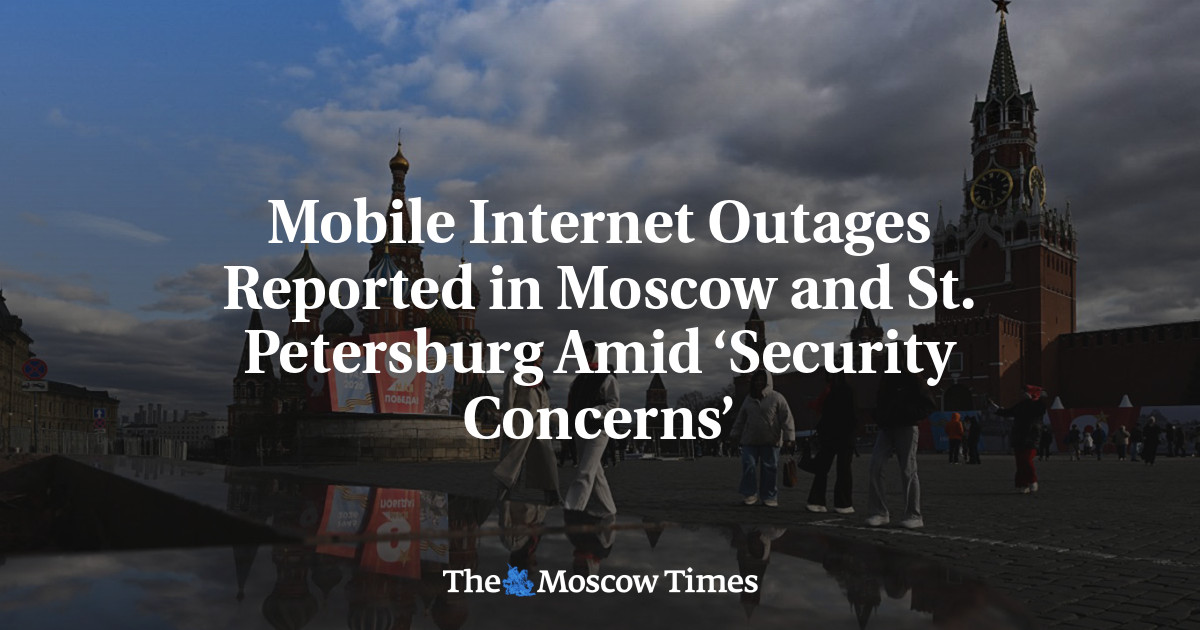
Moscow and St. Petersburg experienced widespread mobile internet outages on Tuesday, with authorities saying temporary restrictions were imposed for security reasons ahead of Victory Day celebrations. The Digital Ministry said initial restrictions in Moscow had ended by midday, but further disruptions remain possible as officials work with law enforcement on a protected website whitelist. The outage affected mobile internet, SMS services, and some whitelist services, while Wi-Fi access largely remained available.
This is less a pure telecom event than a short-duration stress test of Russia’s domestic digital plumbing. The first-order effect is obvious: mobile data downtime shifts activity to fixed-line and in-venue Wi-Fi, but the second-order effect is more interesting — payments, ride-hailing, and consumer auth flows all rely on SMS and app-based verification, so even “restored” connectivity can still produce transaction friction and conversion leakage for hours after the network comes back.
The larger signal is that authorities are normalizing selective, security-driven throttling of connectivity ahead of politically sensitive windows. That tends to widen the gap between Russian consumer internet usage and regulated state-friendly platforms, while penalizing any service architecture that depends on always-on mobile authentication, geolocation, or real-time dispatch. Over time, this incentivizes local platforms with stronger offline tolerances and hardens a “sovereign internet” stack, but it also increases operating complexity and user churn.
The key risk window is the next 3-7 days: if disruptions recur around parade-related security alerts, the market should expect a measurable hit to high-frequency consumer activity, urban mobility, and small-ticket e-commerce in Moscow/St. Petersburg. The longer tail risk is that this becomes a template for broader city-level shutdowns during future drone threats, raising the probability of fragmented digital access and lower trust in mobile-first services. That is economically modest in aggregate, but enough to matter for discretionary spend, ad conversion, and app engagement metrics.
The contrarian read is that this is not uniformly bearish for all domestic tech — it may accelerate usage concentration in incumbents that are already on the whitelist and can operate through sanctioned channels. The real losers are services with thin margins and high dependency on SMS/real-time connectivity, not the platform layer itself. In that sense, the most durable trade is less about betting on a broad tech drawdown and more about targeting businesses whose unit economics break when mobile auth and dispatch reliability degrade.
AI-powered research, real-time alerts, and portfolio analytics for institutional investors.
Request DemoOverall Sentiment
mildly negative
Sentiment Score
-0.20
