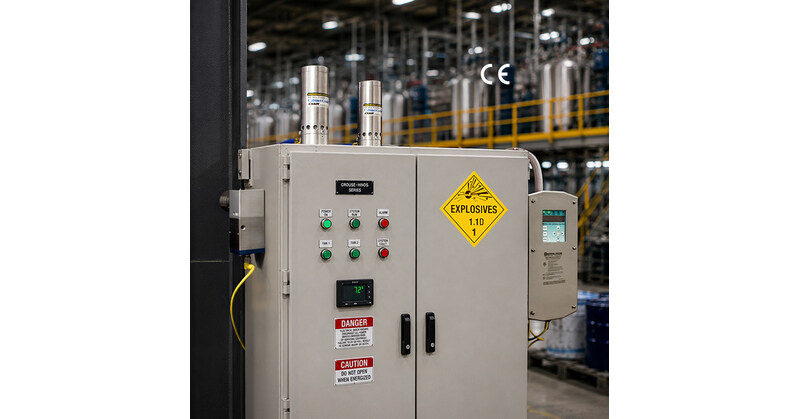
EXAIR launched Dual Hazardous Location Cabinet Cooler Systems for classified environments (e.g., Class I Div 1 and Class II Div 1), offering cooling capacities up to 5,600 Btu/hr. The system uses two cabinet coolers to evenly distribute cold air, is UL tested for hazardous locations, and is positioned as maintenance-free with no moving parts or refrigerant upkeep.
This reads more like a product-line defense move than a demand signal. The economic takeaway is that hazardous-area customers are willing to pay for lower-maintenance, retrofit-friendly thermal management, which shifts spend toward electrical safety and enclosure management rather than toward service-heavy cooling systems. That is mildly supportive for industrial electrical suppliers with adjacent enclosure franchises like ETN and NVT, but the revenue pool is small enough that any public-market impact should be measured in mix and sentiment, not earnings.
The second-order effect is on aftermarket economics: a maintenance-free solution reduces recurring service revenue for traditional compressor/fan-based cabinet cooling vendors and may shorten replacement cycles when plants use scheduled shutdowns to upgrade critical panels. Distribution channels such as GWW and FAST can pick up incremental SKU breadth, but this is likely a basis-point tailwind unless the message is backed by broader industrial retrofit budgets. The market should be skeptical of a press release as proof of traction; the real tell is whether electrical backlog and thermal-management orders improve across multiple suppliers.
Time horizon matters. Near term, there is probably no tradable catalyst. Over 1-3 months, the confirmation path is order commentary from ETN/NVT/ROK-style industrial names and distributor checks; over 6-18 months, the structural theme is industrial electrification in harsher environments, but only if capex stays firm despite softer PMI data. The thesis is falsified if management teams cite deferred project work, if electrical backlog slows, or if plant maintenance budgets tighten more than replacement demand grows.
AI-powered research, real-time alerts, and portfolio analytics for institutional investors.
Overall Sentiment
neutral
Sentiment Score
0.10
